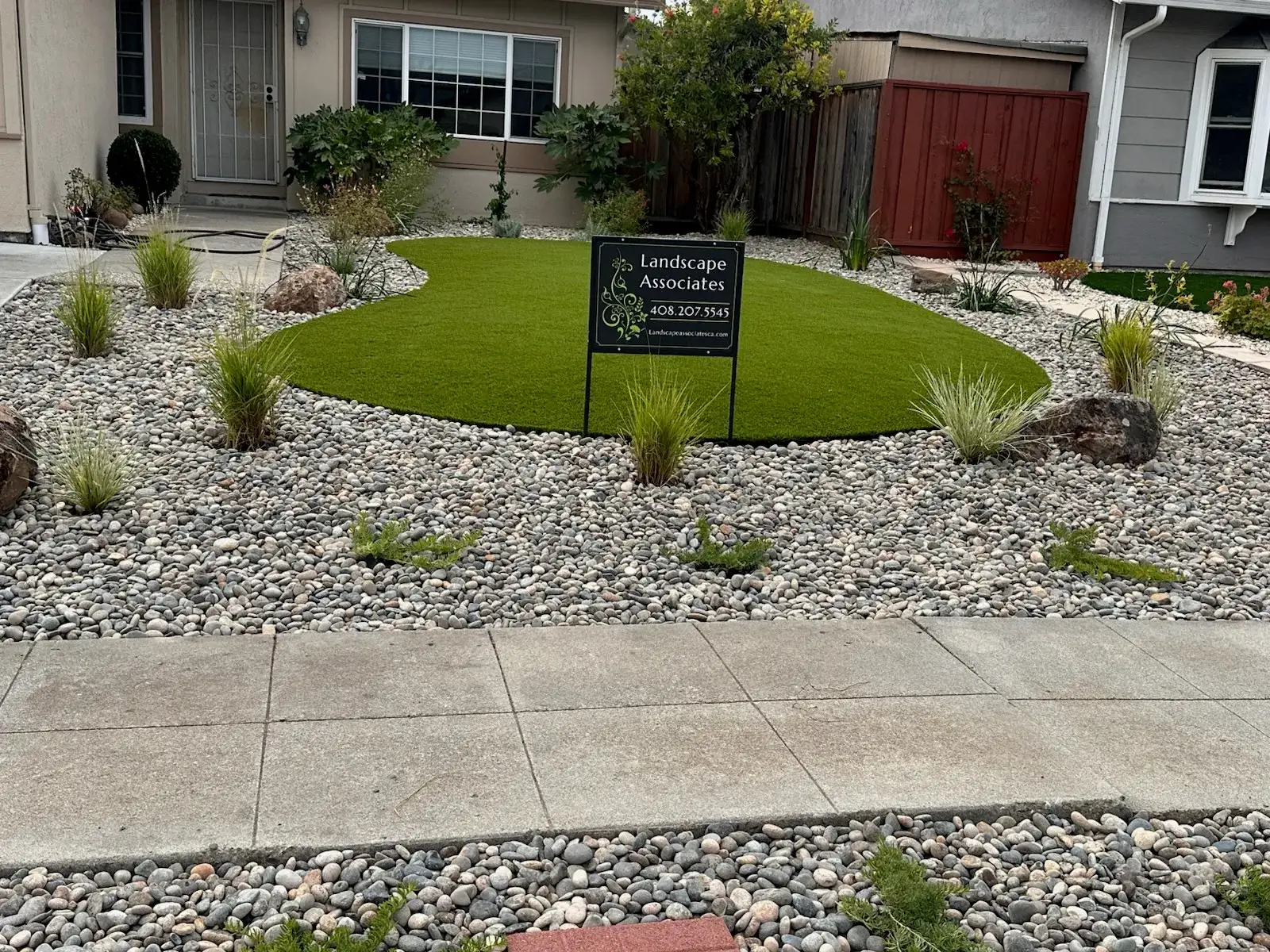
For San Jose artificial turf budgeting, use the published California installation range of $8 to $15 per square foot. Turf selection, base and drainage preparation, and yard access shape the project price. At Landscape Associates of CA, we are fully insured and offer a free on-site estimate, with an itemized quote for the lawn you plan to replace.
Artificial turf cost in San Jose at a glance
- Use our California installation range of $8 to $15 per sq ft for San Jose planning.
- A 500 sq ft lawn gives 500 x $8 = $4,000 to 500 x $15 = $7,500.
- David prices putting greens from $7,000 to $15,000.
- Valley Water excludes artificial turf from landscape rebates: program terms (checked October 2026).
- Carmel-by-the-Sea prohibits new installation, repair and replacement: Policy 2025-02 (checked October 2026).
| Project | Size | Price range | Notes |
|---|---|---|---|
| Smaller lawn | 500 sq ft | $4,000 to $7,500 | 500 x $8 = $4,000; 500 x $15 = $7,500. |
| Medium lawn | 1,000 sq ft | $8,000 to $15,000 | 1,000 x $8 = $8,000; 1,000 x $15 = $15,000. |
| Larger lawn | 2,000 sq ft | $16,000 to $30,000 | 2,000 x $8 = $16,000; 2,000 x $15 = $30,000. |
Measure the area that will actually receive artificial lawn. Keep paving, planted beds and a separate golf surface outside that total. We use the outline to plan seams, edges and access for preparation. A rectangle and a narrow winding strip can have the same area but require different fitting.
How artificial turf pricing works
The installed square foot covers a constructed surface, not simply a roll of synthetic grass. We remove the specified existing material, shape the ground, compact the aggregate base and fit the turf above it. Stable support keeps the finished lawn from following every depression in the soil beneath.
Seam tape joins neighboring pieces, and perimeter fastening holds the edges in place. Infill supports the selected fibers according to the product specification. The backing and the prepared layers must allow water to reach a suitable destination. A surface that lets water through cannot solve saturated ground underneath by itself.
We treat materials, fitting labor, base preparation and basic drainage as parts of the installation comparison. Demolition, haul-off, special access, separate drainage corrections, engineering and applicable permits are itemized in the estimate. Those entries explain the complete job instead of hiding ground preparation inside a material-only number.
SYNLawn and Purchase Green are named product options. We select for the intended use, then compare the backing, infill and maintenance instructions as an assembly. Pet use and golf practice place different demands on that selection; the color of the fibers alone does not tell you how either area should be built.
Cost by type
| Type | Best for | What changes the price | Relative cost |
|---|---|---|---|
| Standard pile | General lawn appearance and everyday use | Fiber choice, outline, seams and preparation | mid |
| Pet turf | An area used regularly by dogs | Drainage, cleaning access and specified infill | higher |
| Putting green | Golf practice | Contours, cups and smoothness | higher |
| Sod | A living grass alternative | Soil preparation, irrigation and upkeep | lower |
Standard pile for a general lawn
Standard artificial grass is selected around use, feel and appearance. We lay neighboring pieces with compatible pile direction so a seam does not create an obvious change in shading. The outline, backing and infill matter alongside the product name. Broad, simple shapes can be easier to fit than many narrow sections.
Pet turf and cleaning access
A pet area needs a surface and base that allow cleaning water to move away. We consider the backing, infill and edges together, including access for removing solid waste. Odor care remains part of ownership. Buying a product labeled for pets does not eliminate the need to prepare the ground beneath it.
Putting greens and ball roll
A putting green needs a carefully shaped base because small surface irregularities affect ball movement. Cups, contours and the surrounding fringe change the fitting work. David prices putting greens from $7,000 to $15,000; that project range stands apart from the general lawn rate rather than being calculated from it.
Sod as the living alternative
Sod establishes a real grass surface over prepared soil and needs irrigation and mowing. Sod usually starts lower in cost than artificial turf, then carries water, mowing and fertilizer every year, while synthetic grass needs brushing, rinsing and infill top-ups instead. Neither choice is maintenance free.
What moves the price
Area, outline and roll layout
The finished outline determines how pieces meet and where seams fall. A simple rectangle allows a different cutting plan from islands wrapped around planting beds. We measure those boundaries before ordering so the layout accounts for fitting, rather than assuming every purchased piece becomes uninterrupted visible lawn.
Existing grass and removal
Removing old sod includes the organic layer that would otherwise remain under the new aggregate. Existing edging, roots and adjoining paving can change the excavation. We identify disposal separately from selecting fibers, because a replacement lawn requires work that a product sample cannot show.
Base shaping and compaction
We shape support before fitting the surface, keeping depressions from becoming hidden low spots. Aggregate selection and compaction have to suit the proposed assembly. A putting green needs especially careful contours, while an everyday lawn still requires a stable platform rather than loose fill concealed by the backing.
Water movement below the backing
Standing water belongs in the design discussion before the roll is laid. We trace where runoff and subsurface moisture can go, adding a separate correction where needed. The French drain cost guide explains outlets and restoration that extend beyond ordinary lawn preparation.
Edges beside paving and retaining work
A perimeter against a path needs a secure, compatible transition. We coordinate the finished level with the paver patio layout and keep retaining construction separate where soil levels change. Burying an edge or outlet under infill can create later maintenance problems.
Access, slopes and phased construction
Aggregate and removed soil must travel between the work area and the delivery point. Narrow gates and slopes affect that handling. We keep access open until heavy preparation is complete, then fit the finished grass. Laying the surface before adjoining masonry can expose it to avoidable construction traffic.
Worked examples
For 500 sq ft of artificial lawn, use 500 x $8 = $4,000 at the lower endpoint and 500 x $15 = $7,500 at the upper endpoint. This California rate supports the San Jose planning example. The measured outline still needs a seam layout and preparation suited to the existing ground.
For 1,000 sq ft, multiply 1,000 x $8 = $8,000 and 1,000 x $15 = $15,000. We keep adjoining pavers outside that multiplication. If the lawn wraps around a bed, the bed stays out of the finished area while its perimeter remains part of the fitting work.
For 2,000 sq ft, the calculations are 2,000 x $8 = $16,000 and 2,000 x $15 = $30,000. These endpoints do not assume a bulk discount. A larger lawn still needs the specified support, water route and secure seams, rather than a reduced preparation standard to fit a target total.
What a set budget buys in lawn area
At $8 to $15 per sq ft, $5,000 buys roughly 335 to 625 sq ft of artificial lawn, $15,000 roughly 1,000 to 1,875 sq ft, and $40,000 roughly 2,700 to 5,000 sq ft. Removal of the old lawn and any drainage correction reduce the area the same money covers, and a putting green is priced as its own project at $7,000 to $15,000.
Cost in Saratoga, Los Gatos, Los Altos, Monte Sereno, Monterey and Carmel
| City | Published range | The local rule that affects the job | Link |
|---|---|---|---|
| San Jose | $8 to $15 per sq ft, California guide | Synthetic lawn is excluded from Valley Water rebates. Landscape rebate terms (checked October 2026) | San Jose |
| Saratoga | priced at the estimate | Hazard-area clearance covers new structures, additions and basements, not an automatic lawn charge. Geotechnical page (checked October 2026) | Saratoga |
| Los Gatos | priced at the estimate | Protected tree removal needs approval; preserve that distinction when changing lawn edges. Town tree FAQ (checked October 2026) | Los Gatos |
| Los Altos | priced at the estimate | Tree removal approval covers protected specimens, including native species at 10 in diameter. Removal process (checked October 2026) | Los Altos |
| Monte Sereno | priced at the estimate | Associated walls not over 4 ft from footing bottom to top are building-permit exempt unless carrying surcharge. Building FAQ (checked October 2026) | Monte Sereno |
| Monterey | priced at the estimate | MPWMD accepts synthetic turf for its lawn-removal program subject to eligibility and local rules. District rebate (checked October 2026) | Monterey |
| Carmel | Unavailable inside Carmel-by-the-Sea | New synthetic installation, repair and replacement are prohibited within the city. City policy (checked October 2026) | Carmel |
Saratoga and Los Gatos hillside lawns are priced from their own access, slope and preparation needs. Los Altos Hills is also within our service area. In the Monterey Peninsula, establish the jurisdiction before selecting a surface, because Carmel Valley and Pebble Beach are outside Carmel-by-the-Sea.
Permits, rebates and water rules
Valley Water excludes synthetic grass
Valley Water does not rebate artificial turf, so we do not deduct lawn-conversion money from a San Jose synthetic budget. For qualifying plant conversions instead, apply and receive the Notice to Proceed before work or equipment purchases. Lawn must remain for pre-inspection. See Valley Water landscape conditions (checked October 2026).
Carmel prohibits future turf work
Policy 2025-02 prohibits future installation, repair and replacement of artificial turf in Carmel-by-the-Sea, so it is not an option inside the city limits. Existing turf is not ordered removed. The policy does not extend to Carmel Valley or Pebble Beach; see Carmel policy handouts (checked October 2026).
MPWMD lawn removal eligibility
MPWMD lists synthetic turf as acceptable, subject to local rules, at $1 per sq ft up to 2,500 sq ft with a 250 sq ft minimum. Eligible water-system customers within the District apply within 120 days of purchase; funding is first come, first served. See MPWMD landscape rebates (checked October 2026).
MPWMD deed restriction and irrigation
The MPWMD program requires a 15-year deed restriction against reinstalling lawn anywhere on the property. Irrigation in the converted area must be drip. District coverage includes Carmel Valley and Pebble Beach, but acceptance never overrides the city ban. Read District conditions (checked October 2026) and Carmel restrictions (checked October 2026).
Saratoga clearance for associated structures
In Saratoga geologic hazard areas, including hillside and creek-side examples, new structures, additions and basements require geotechnical clearance. The City’s page does not specifically address artificial turf, so this is a scope question for a broader project, a distinction for any combined construction scope. See Saratoga geotechnical review page (checked October 2026).
How the project runs
Step 1: Review the lawn and intended use
We inspect the existing grass, wet areas and access at the free visit. Pet use, play and golf practice lead to different surface choices. The itemized proposal records the measured outline and preparation so the comparison describes more than a roll selected from a sample.
Step 2: Design seams, edges and contours
David can design the yard with you or build to supplied plans. We position seams and edge transitions around the intended use, with contours planned before installation. Engineering for any associated structure stays separate from the synthetic lawn selection and is identified where the combined design requires it.
Step 3: Resolve local eligibility and approvals
Carmel-by-the-Sea excludes future turf work under its artificial turf policy (checked October 2026). For eligible Peninsula conversions elsewhere, MPWMD terms (checked October 2026) govern the rebate application. Ask us about permit responsibility for associated construction; a rebate program does not settle every local approval.
Step 4: Prepare support and fit the grass
We remove the specified existing material, form the ground and compact the supporting aggregate. Water routes are addressed before backing covers the surface. Turf pieces are fitted with consistent pile direction, joined using the appropriate seam system, secured at the perimeter and finished with the specified infill.
Step 5: Brush fibers and clear the edges
Finishing includes brushing the surface as the chosen system requires and clearing loose construction material. We keep drains and neighboring planting distinct from infill. The completed outline should meet the paving or edging established in the design without covering access points needed for future cleaning.
Step 6: Walk the lawn and explain care
The walkthrough follows seams, boundaries and the water route, with care matched to ordinary use or pets. We review the applicable written coverage alongside those responsibilities. Synthetic grass still needs debris removal and attention to infill, so the finished handover includes more than a view of the green surface.
How to keep the cost down without a cheap job
- Size the artificial lawn around actual use instead of replacing every planted corner.
- Choose an efficient outline that reduces narrow pieces and complicated seams.
- Compare product options with identical base preparation and perimeter details.
- Address saturated ground before paying for the finished backing and fibers.
- Keep golf contours and cups in a separate putting green proposal.
- Complete adjacent blockwork before bringing new turf onto the job.
- Plan cleaning access for pet areas when setting the borders.
Mistakes that make it cost more later
Covering an unstable lawn base
Loose aggregate and uncorrected depressions remain beneath synthetic grass. Fitting the surface tightly does not stabilize those layers. We prepare support while it is accessible; trying to correct movement afterward means disturbing seams and infill to reach the ground that should have been shaped first.
Expecting pet turf to clean itself
Pet waste still requires removal, and cleaning water needs somewhere to go. Backing, infill and the underlying assembly determine how that routine works. A pet label alone cannot overcome trapped moisture, blocked discharge or edges that prevent the homeowner from reaching the area for maintenance.
Counting on the wrong lawn rebate
Valley Water excludes artificial turf under its landscape program (checked October 2026). Subtracting a plant-conversion payment from the synthetic total creates a false budget. Select the replacement landscape before calculating assistance, and preserve existing lawn until any required inspection for the chosen program is complete.
Using lawn arithmetic for a putting green
Golf contours and cup installation require a different finish from an ordinary artificial lawn. The published $7,000 to $15,000 green range addresses that separate project. Applying the lawn unit rate to a practice area can hide shaping work that directly affects how the ball rolls.
What is in a Landscape Associates estimate
Artificial turf carries a 15-year warranty from Landscape Associates. We itemize the proposed work after a free property visit, with coverage and care terms reviewed alongside the selected product. David Muhoberac founded the business in 1987; inquiries receive a response within 24 hours.
- Measured lawn outline, intended use and selected synthetic surface.
- Removal and disposal, ground shaping and compacted support.
- Seams, perimeter fastening, infill and finish brushing.
- Separate drainage correction, special access and associated approval or engineering work.
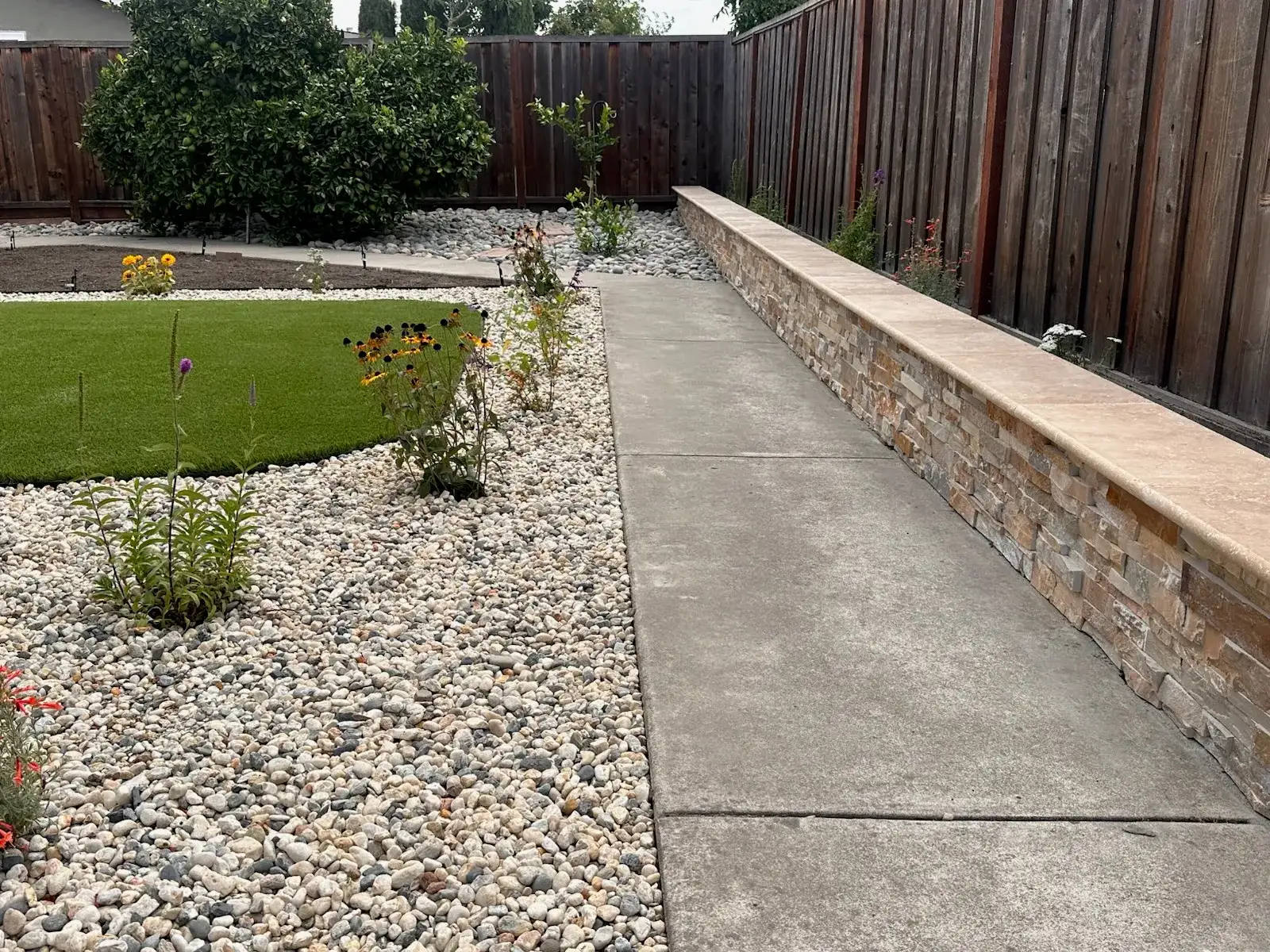
Our artificial turf and sod service compares lawn options. Use the San Jose landscaping cost guide and Saratoga landscaping cost guide when the plan also includes paving, planting or retaining work beyond the grass surface.
Sources and how we price
- Valley Water Landscape Rebate terms (checked October 2026)
- MPWMD Landscape Rebates (checked October 2026)
- Carmel Policy 2025-02 handouts (checked October 2026)
- Saratoga Geotechnical Clearance (checked October 2026)
- Los Gatos tree protection FAQ (checked October 2026)
- Los Altos tree removal handout (checked October 2026)
- Monte Sereno Building FAQ (checked October 2026)
The lawn figures are our published California installation range used for San Jose planning, alongside our own San Jose and Saratoga landscaping guides. We refresh them when the estimate book changes. Every job receives its price at a free on-site visit, where the backing, preparation and fitted outline become a defined scope.
For a free on-site lawn estimate, reach us by call or text at (408) 207-5545. We reply within 24 hours and can compare the intended lawn area with your paving, planting and pet needs.
Questions homeowners ask
How much does 500 square feet of artificial turf cost?
For a San Jose artificial lawn of 500 sq ft, the published California rate gives 500 x $8 = $4,000 and 500 x $15 = $7,500. We measure the finished outline and identify preparation, seams and edging before quoting the project. Paving and planted beds remain outside that turf-area calculation.
How much does 1,000 square feet of artificial turf cost?
A San Jose artificial turf area of 1,000 sq ft gives 1,000 x $8 = $8,000 to 1,000 x $15 = $15,000 using the California guide. Product selection and the supporting assembly shape the final scope. A putting green or adjoining patio receives a separate line instead of being assumed inside that lawn amount.
How much does a backyard putting green cost?
David prices artificial turf putting greens from $7,000 to $15,000 for homeowners planning a San Jose yard. Contours, cups and the finished ball-roll surface distinguish golf practice from a general lawn. We define that work separately, because multiplying ordinary lawn square footage does not describe the shaping and fitting needed by a green.
Does pet turf cost more than regular artificial grass?
Pet turf in San Jose can involve different backing, infill and preparation from a general artificial lawn. Cleaning water needs a path through the assembly, and solid waste still needs removal. We price the complete pet system on the same outline as a standard lawn so the difference is visible line by line.
Is artificial turf cheaper than sod over time?
San Jose artificial turf and sod have different ownership costs, without a published break-even figure. Living grass needs mowing and irrigation; synthetic surfaces need cleaning, debris removal and product-specific care. We compare the installation scope and how you will use the area before treating either material as the less expensive long-term choice.
Does Valley Water give a rebate for artificial turf?
Artificial turf in San Jose does not qualify for a Valley Water landscape rebate. A qualifying plant conversion follows different requirements, including a Notice to Proceed before work or equipment purchases and lawn remaining for inspection. Do not deduct that payment from a synthetic installation. See Valley Water rebate rules (checked October 2026).
Is artificial turf banned in Carmel?
Artificial turf installation, repair and replacement are prohibited in Carmel-by-the-Sea under Policy 2025-02. Existing turf is not ordered removed, and the ban does not extend to Carmel Valley or Pebble Beach. Establish the actual jurisdiction rather than relying on a mailing address. The source is Carmel policy information (checked October 2026).
Does MPWMD rebate synthetic turf in Monterey?
MPWMD lists synthetic turf as acceptable for eligible Monterey Peninsula lawn removal, subject to local rules. The rebate is $1 per sq ft up to 2,500 sq ft, minimum 250 sq ft, with a 15-year deed restriction. Apply within 120 days of purchase, while funding lasts. See District rebate conditions (checked October 2026).
Does artificial turf get hot in the sun?
Artificial turf in a sunny San Jose yard can feel hot, so exposure matters when choosing where children or pets will use the surface. We consider shade and intended activity during layout. No temperature reduction is published for a particular product; select backing and infill for their documented use and follow the care instructions.
Do I need drainage under artificial turf?
San Jose artificial turf needs a prepared assembly that allows water to leave the surface and reach a suitable destination. Permeable backing alone cannot correct saturated ground. We inspect wet areas before installation and distinguish basic preparation from a separate French drain or other correction, keeping the complete water route in the proposal.
What is the warranty on artificial turf?
Our San Jose artificial turf installations carry a 15-year warranty. Written coverage, exclusions and care requirements should accompany the selected surface and installation scope. That period does not establish a replacement schedule. We review maintenance for seams, edges and infill so the homeowner understands the responsibilities attached to the proposed lawn.
How do you maintain artificial turf?
A San Jose artificial turf lawn needs debris removal, cleaning and brushing appropriate to its fibers and infill. Pet areas also need waste removal and attention to drainage. Keep outlets and edges accessible, and follow the chosen product instructions rather than assuming synthetic grass requires no work after the installation is finished.
Get in Touch
Call us, send the estimate form, or email us. We reply within 24 hours to book a free site visit. Call or text (408) 207-5545.
- (408) 207-5545
- david@landscapeassociatesca.com
- Mailing address: 125 Surf Way #443, Monterey, CA 93940
- Mon - Fri: 8:00-5:00 · Closed on weekends