The right yard drainage fix depends on where the water collects and why: on clay soil, water that cannot soak in has to be graded or piped away from the house, which is what regrading, catch basins and French drains each do in different situations.
Why clay soil drains slowly
Clay soil has small pores that slow water movement and hold moisture. That can leave a yard wet after rain, but soil texture is only part of the diagnosis. Low spots, compacted ground and excess irrigation also deserve a look before you decide that a buried drain is necessary.
Oregon State University Extension explains the link between clay’s small pores and slow drainage. For a South Bay homeowner with clay soil, the useful question is whether water is arriving too quickly, collecting in a depression or struggling to move through the ground.
UC Agriculture and Natural Resources recommends checking grading before blaming the soil. Make a note of where the puddle starts and whether it appears after rain, sprinkler use or both. A lawn that stays wet needs investigation beyond its surface appearance.
Drainage problems and the fix that fits
Match the drainage method to the path the water takes. Surface pooling calls for checking grades and collection points; persistent wet ground may need subsurface drainage. Roof runoff deserves its own route away from the foundation. The table gives starting points for an inspection, rather than a diagnosis from appearance alone.
| What you see | Likely cause | Usual fixes | Notes |
|---|---|---|---|
| Standing water in the lawn | A low spot, slow-draining soil or excess irrigation | Regrading; catch basin for surface pooling; French drain where appropriate | Check sprinkler use and the proposed outlet before digging. |
| Water against the foundation | Ground sloping toward the house or nearby roof discharge | Regrading and downspout extensions | Address incoming surface water before choosing buried drainage. |
| Overflowing downspouts | Possible debris blockage or a roof-drainage problem | Gutter/downspout inspection and clearing; then appropriate extension or routing | A yard drain does not clear a blocked downspout. |
| A wet side yard | A low corridor collecting runoff or persistent wet soil | Graded surface route, catch basin or French drain | Check available fall and where the route can end. |
| Erosion on a slope | Runoff concentrated along a downhill path | Vegetated swale or designed dry creek bed | Consider the channel and its outlet together. |
| Water crossing a patio | Upstream runoff or paving sloped toward a problem area | Correct grades or intercept surface water with a drain | Trace the water before deciding where collection belongs. |
Sources: Colorado State University Extension, PNNL’s stormwater guidance, Northern Virginia Soil and Water Conservation District and NC State Extension. These are general drainage principles, not local discharge permissions.
Regrading and downspouts: the first fixes to check
Check whether the ground and downspouts send water toward the house before adding an underground system. Regrading changes the surface slope; a downspout extension moves roof discharge away from the foundation. Either approach still needs a workable destination, so follow the proposed water route all the way to its end.
University of Minnesota Extension advises correcting surface drainage first. Its guidance calls for grading away from the house and using downspout extensions to carry roof runoff away. Above-ground corrections may resolve the source of a problem before below-ground work is needed.
Separate water spilling out of the roof system from water pooling where the downspout empties. NC State’s gutter guidance recommends inspection, maintenance and clear downspout elbows. Have that checked when overflow is visible, then look at where the downspout discharges.
If you are also planning landscape construction, discuss drainage routes alongside the proposed lawn and paving layout. Bring photos of existing puddles so the conversation starts with what happens on your property.
French drain vs catch basin vs dry creek bed
A French drain provides a buried drainage route, a catch basin collects surface water at an inlet, and a dry creek bed carries runoff in a stone-lined channel. The choice depends on how water reaches the problem area and whether there is a suitable route and destination for it.
French drain: a buried route
A French drain commonly uses perforated pipe surrounded by stone and filter fabric. Consider it when the inspection shows that water needs to be collected and carried underground. Water must be able to reach the drain and flow toward its outlet; simply burying pipe in a wet yard is not a complete design.
Catch basin: a surface collection point
A catch basin receives surface runoff through a grate and sends it into an outlet pipe. It fits a low point where water can reach the inlet. A basin can also be part of a larger drainage system, so the choice is not always one device or another.
Dry creek bed: an open runoff channel
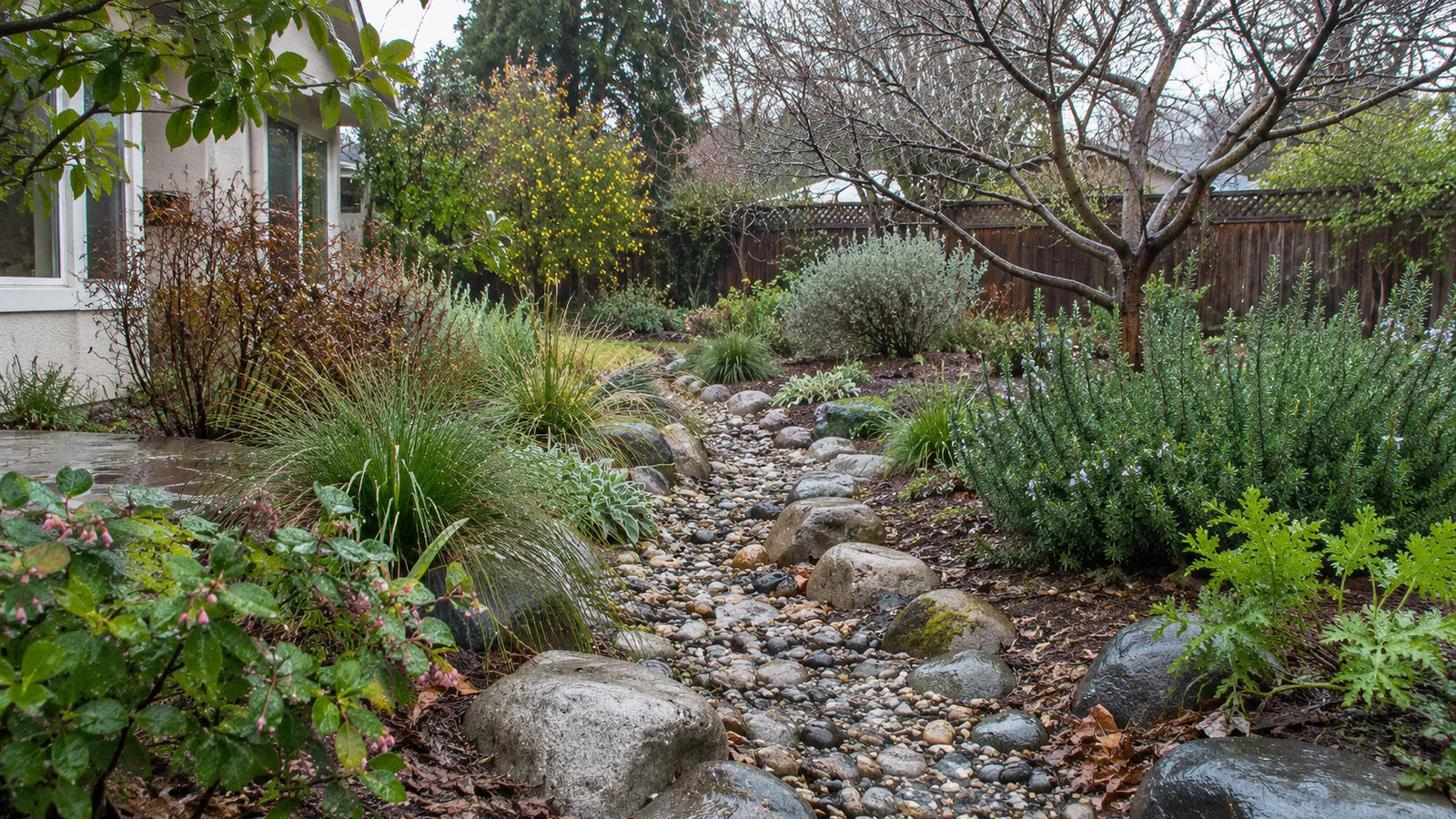
A functional dry creek bed is a stone-lined swale with a planned flow path. Consider it where an open surface channel suits the yard. The stone and channel need to suit the runoff; a decorative ribbon of gravel should not be assumed to provide drainage.
See our guide to French drain cost in San Jose when comparing the proposed work. If paving is also under consideration, read about permeable pavers on clay soil before choosing the finished surface.
Where drainage water is allowed to go
Ask your city about the proposed outlet before planning to send yard water into a street or storm drain. Valley Water’s irrigation runoff restriction does not establish permission for that connection. Keep the questions separate: what is causing the wet area, and where can this property’s drainage water be directed?
Valley Water Ordinance 23-02, Section 3.1(b), prohibits applying potable landscape irrigation in a manner that causes more than incidental runoff. It applies to Santa Clara County properties receiving potable water supplied or managed by Valley Water, directly or through a retailer (checked October 2026).
For a rainwater drainage proposal, ask the city about the exact discharge point. Describe whether the water comes from roof runoff, yard runoff or irrigation. Bring a sketch showing the house, property boundaries, collection area and proposed outlet so the question is specific.
How we approach a drainage problem
We begin with the wet area, the source of the water and its possible route out. Landscape Associates of CA offers a free on-site estimate and itemized project pricing. Our published San Jose drainage-correction range is $1,500 to $8,000, and drainage work carries a two-year warranty.
Walk the yard after rain if possible, and save photos for the visit. Point out water near the house, the side yard and patio edges, including places that have dried by the appointment. Ask which symptoms each proposed change addresses and what the quote includes for restoring disturbed surfaces.
The range covers San Jose drainage corrections, not a fixed price for every French drain or an entire backyard renovation. Review the proposed work and warranty terms at the estimate. Our drainage solutions page explains the service options.
Frequently asked questions
Choosing among backyard drainage solutions starts with separating the water source from the place it collects. These answers explain what each option is intended to do and what to ask before accepting a proposal. For a particular yard, the grade, soil conditions and discharge location still need an on-site assessment.
What is the best drainage solution for a yard with clay soil?
The best option depends on whether the problem is surface runoff, a low spot or water held in the soil. Check grading and roof-water discharge first. A catch basin may suit a surface collection point, while a French drain may suit underground drainage. An open swale can provide another route. Ask for a plan that identifies both the water source and the destination.
How do I stop water pooling in my backyard?
Begin by identifying what feeds the puddle and whether it occupies a low spot. Note when it appears, check sprinkler use and trace nearby downspouts. Depending on the findings, the proposal may involve correcting grades, redirecting roof water or adding collection and drainage. Photograph the area after rain and ask which cause each proposed repair addresses before agreeing to excavation or replacing the lawn.
What is the difference between a French drain and a catch basin?
A French drain provides underground drainage, while a catch basin admits surface water through a grate. The French drain commonly includes perforated pipe in stone; the basin connects a collection box to an outlet pipe. They can work together in one system. For a puddle, ask how water will reach the collection point and where the pipe will carry it afterward.
Does a dry creek bed actually drain water?
A properly designed dry creek bed can convey runoff along a stone-lined surface channel. Its function depends on the channel’s route and destination, rather than the appearance of the stones. Ask where water enters, how it travels through the yard and where it leaves the channel. Do not assume the underlying clay will absorb everything or that a decorative gravel strip solves persistent wet ground.
How much does it cost to fix yard drainage in San Jose?
The published range for San Jose drainage corrections is $1,500 to $8,000. That is a project range, not a per-foot rate or a quote for every property. Use the on-site estimate to establish the actual scope. Ask the estimator to identify the collection method, outlet work and restoration included in the proposal so you can compare itemized quotes for the same work.
Can I drain yard water into the street?
Ask your city whether your proposed yard-water discharge point is acceptable before routing water to the street. Do not treat an irrigation runoff rule as authorization for a stormwater connection. Explain the source of the water and show the intended pipe or surface route. Get the outlet question answered as part of planning the work, before choosing a drain solely because it fits the wet spot.
Water pooling in your yard?
Tell Landscape Associates of CA where water collects and when it appears. Call or text (408) 207-5545, email david@landscapeassociatesca.com, or get a free on-site estimate. We reply within 24 hours. Have your questions and any after-rain photos ready to discuss the drainage work your yard may need.
Get in Touch
Call us, send the estimate form, or email us. We reply within 24 hours to book a free site visit. Call or text (408) 207-5545.
- (408) 207-5545
- Text (408) 207-5545
- david@landscapeassociatesca.com
- Mailing address: 125 Surf Way #443, Monterey, CA 93940
- Mon - Fri: 8:00-5:00 · Closed on weekends