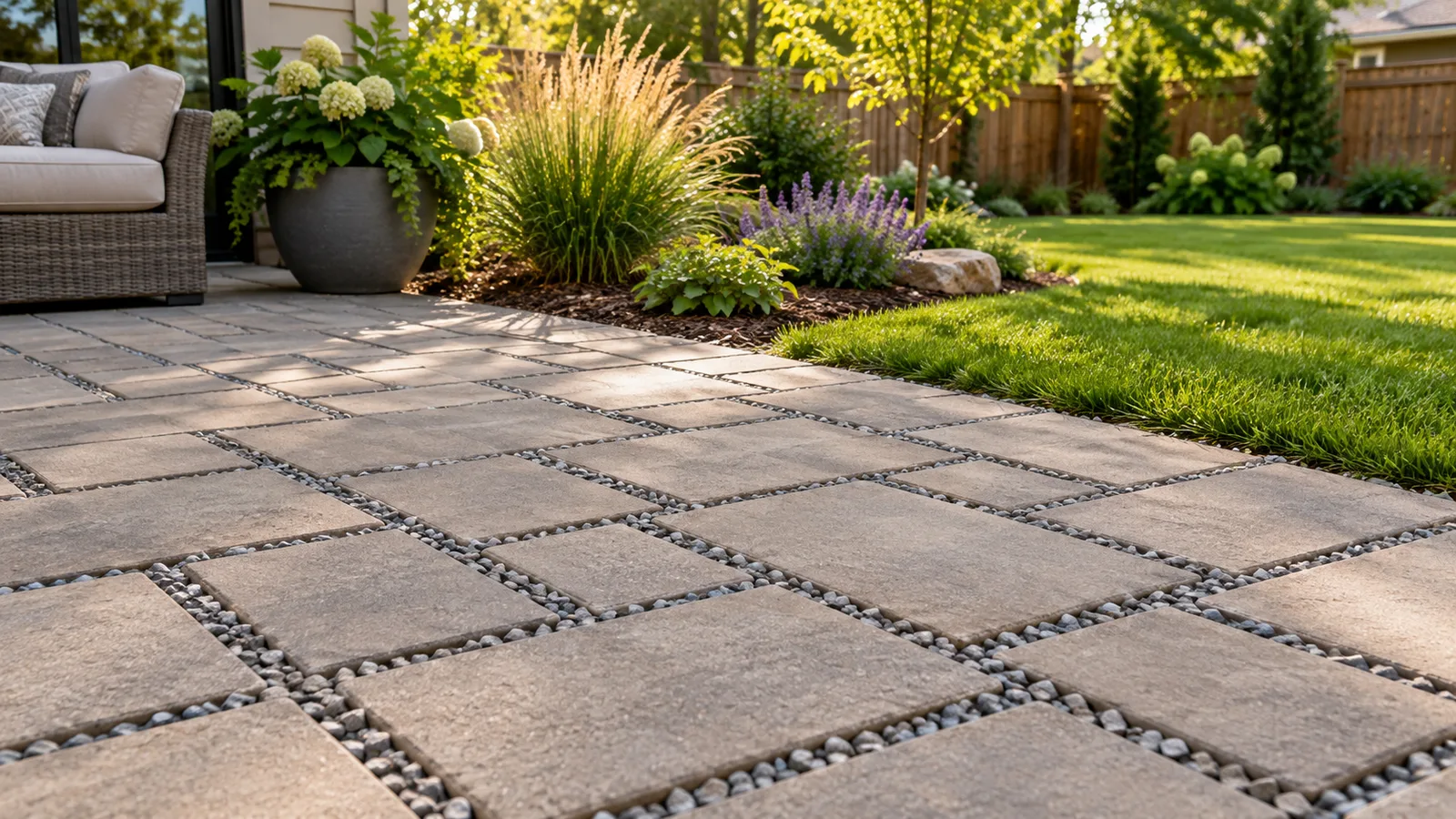
Permeable pavers can be built on clay soil, but because clay drains slowly the system is usually designed to store water in a deeper stone base and release it through an underdrain rather than relying on the soil alone. The depth is calculated for the particular site, not selected from a universal clay-soil recipe. Industry guidance allows water to enter the ground, leave through drainage pipes, or do both. The key questions are how quickly your soil accepts water, how much runoff the pavement must hold, and where excess water can go. A permeable surface can be part of a drainage plan, but it is not a promise that a wet yard will stop flooding. We install permeable paver systems for driveways, patios and walkways.
How permeable pavers handle water
Permeable interlocking concrete pavement lets water pass through stone-filled joints into open-graded aggregate below. That buried layer provides storage as well as support. The Concrete Masonry and Hardscapes Association describes three arrangements: full infiltration, partial infiltration and no infiltration. Each manages the water differently after it passes through the surface.
The visible paving is only the top of the assembly. Its joints, bedding, stone reservoir and drainage details have to work together. Wider gaps alone do not turn an ordinary patio into a designed stormwater system.
- Full infiltration: Water moves through the stone base into the soil underneath, with provision for overflow.
- Partial infiltration: Some water enters the soil; drainage pipes carry excess water out of the system.
- No infiltration: The pavement stores water for discharge through an outlet rather than depending on absorption into the underlying soil.
These are the terms in CMHA Tech Note PAV-TEC-018. They describe the entire pavement system, not different decorative finishes. A surface can accept rainfall even when the design does not send that water into the clay beneath it.
Why clay soil changes the design
Clay changes the design because getting water through the surface is different from getting it into the ground. CMHA identifies partial infiltration as common for lower-infiltration soils such as silts and clays. Storage and drainage therefore need attention alongside the strength needed to support the finished pavement.
The stone reservoir temporarily holds water in the spaces between the aggregate. An underdrain gives excess water a route out. Its outlet is part of the design, not something to resolve after the patio has been laid.
Base thickness must satisfy both the water-storage calculation and the structural requirement. CMHA says the thicker of those calculated sections is selected. Storage can require more depth than supporting traffic alone, which explains the deeper-base language; it does not mean every clay yard needs the same excavation.
Ask what evidence supports the proposed system: soil conditions, infiltration testing, the area contributing runoff and a workable discharge route. A neighbor’s successful patio does not establish those conditions on your property.
Matching the design to your soil
Permeable pavers can be built on clay soil, but because clay drains slowly the system is usually designed to store water in a deeper stone base and release it through an underdrain rather than relying on the soil alone. Site conditions determine the final design.
| Soil condition | What it means | Typical design response |
|---|---|---|
| High-infiltration soils such as sands and gravels | The ground can receive water from the reservoir. | Full infiltration, with an overflow route. |
| Lower-infiltration soils such as silts and clays | The ground accepts some water, but excess water needs another route. | Partial infiltration using reservoir storage and drainage pipes. |
| Very low permeability, low soil strength or other limiting site conditions | Infiltration into the underlying soil may not be appropriate. | No infiltration with an outlet; a geomembrane may be part of the site-specific design. |
Source: Concrete Masonry and Hardscapes Association, Construction of Permeable Interlocking Concrete Pavement Systems, PAV-TEC-018, revised 2022.
Use the table to understand a proposal, not to select construction details yourself. Soil strength, groundwater, nearby structures, runoff sources and slope can change what is appropriate. The introductory sentence describes a common clay-soil approach; the table also shows why some sites need a different arrangement.
Permeable vs regular pavers on a clay lot
The practical choice is between a conventional paved surface with planned drainage and a pavement system designed to receive and store water below its joints. Compare the complete work, including excavation, base materials, drainage connections and maintenance. A price for ordinary paving does not establish the price of a permeable system.
For a conventional patio budget, the published paver patio cost in San Jose is about $15 to $30 per square foot installed. That is a patio planning figure, not a permeable-paver quote. Do not apply it to a specified reservoir and underdrain without an itemized estimate for that work.
Maintenance is another difference. CMHA’s permeable pavement maintenance guide explains that trapped sediment can reduce surface infiltration. Appropriate vacuum cleaning and replenishing joint stone are part of maintaining the system. Keep soil and mulch from washing onto it, and discuss a maintenance plan before choosing the pavement.
Ask each bidder to describe the same scope. Otherwise, a surface-only comparison can hide the very storage and outlet work that makes a permeable installation useful on slow-draining ground.
Drainage on clay lots without permeable pavers
Permeable paving is one option within a drainage plan. Where the problem involves runoff moving toward a low spot, grading or a collection drain may be more relevant than changing the pavement surface. First identify where the water comes from, where it collects and where it can safely go.
Consider drainage solutions before committing to a new patio solely to address standing water. Describe whether the problem follows rain, appears near an irrigated bed, or occurs beside an existing paved area. Photos taken during the problem can make that conversation more useful.
The French drain cost guide discusses another approach. A drain still needs a suitable destination for collected water. Neither a French drain nor permeable paving should be treated as a guaranteed cure for flooding without evaluating the site.
How we approach it
We start with a free on-site estimate and look at the soil, drainage and slope of the ground. We discuss where you want paving and how you will use it. That conversation helps separate the surface you want from the drainage questions that the proposal needs to answer.
Our paver patios and driveways page describes the available paving work. Bring questions about the proposed base, water storage, outlet and upkeep. Ask what further testing or specialist design is needed for your particular lot; a visual site visit should not be mistaken for a measured infiltration result.
Frequently asked questions
Clay soil does not settle every permeable-paving question by itself. The answers depend on the complete assembly, the conditions below it and the route for excess water. These questions help you review a proposal without treating a general explanation as a construction specification for your own yard.
Do permeable pavers work on clay soil?
Permeable pavers can work on clay soil when the system is designed for the site. The surface lets water enter an aggregate reservoir, while an underdrain can carry excess water away. CMHA identifies partial infiltration as common for silts and clays. Very low permeability or weak soil may call for a no-infiltration design instead. Soil conditions and a suitable outlet matter more than the paver appearance.
Do permeable pavers need an underdrain?
Permeable pavers do not always need an underdrain, but lower-infiltration soils often call for one. A full-infiltration system relies on the ground beneath it, while partial infiltration combines soil absorption with drainage pipes. A no-infiltration system needs an outlet for stored water. The choice should follow the site assessment and water-management design, including how overflow will be handled, rather than an assumption that every permeable patio drains the same way.
How deep is the base for permeable pavers?
There is no single base depth that fits every permeable-paver project on clay. CMHA calls for thickness to be determined for both hydrological needs and structural loading, then uses the thicker section. A driveway and a pedestrian patio may therefore have different requirements, and water storage can govern the depth. Ask for the proposed section and its design basis instead of accepting a generic depth as proof that drainage will work.
Are permeable pavers more expensive than regular pavers?
A permeable system needs its own itemized estimate; an ordinary paver-patio rate does not establish its cost. Compare the proposed excavation, aggregate reservoir, drainage outlet and maintenance requirements with the conventional paving option. The published San Jose paver-patio range is about $15 to $30 per square foot installed, but it is not a permeable-system price. Get comparable scopes before deciding whether the additional water-management work fits your project.
How do you maintain permeable pavers?
Maintain permeable pavers by keeping sediment out of the joints and following a cleaning plan suited to the installation. CMHA describes vacuum cleaning and maintaining the stone-filled joints; soil, leaves and mulch from adjacent areas can contribute to clogging. Cleaning needs vary with the sediment reaching the pavement. Ask which equipment and joint aggregate the system requires, and have persistent ponding investigated rather than assuming an ordinary sweep has restored infiltration.
Do permeable pavers help with yard drainage?
Permeable pavers can help manage runoff when their storage and discharge are designed for the water reaching them. They do not automatically solve standing water elsewhere in a yard. Slow soil absorption, blocked drainage, grades and contributing runoff need to be considered together. On clay, an underdrain or another drainage approach may be necessary. Start with the source and destination of the water before choosing a new pavement surface.
Thinking about permeable pavers?
Tell us where you want paving and what happens to water on the property now. Call or text (408) 207-5545, email david@landscapeassociatesca.com, or get a free on-site estimate. We reply within 24 hours. Bring your questions about the base, drainage outlet and maintenance to the visit.
Get in Touch
Call us, send the estimate form, or email us. We reply within 24 hours to book a free site visit. Call or text (408) 207-5545.
- (408) 207-5545
- Text (408) 207-5545
- david@landscapeassociatesca.com
- Mailing address: 125 Surf Way #443, Monterey, CA 93940
- Mon - Fri: 8:00-5:00 · Closed on weekends