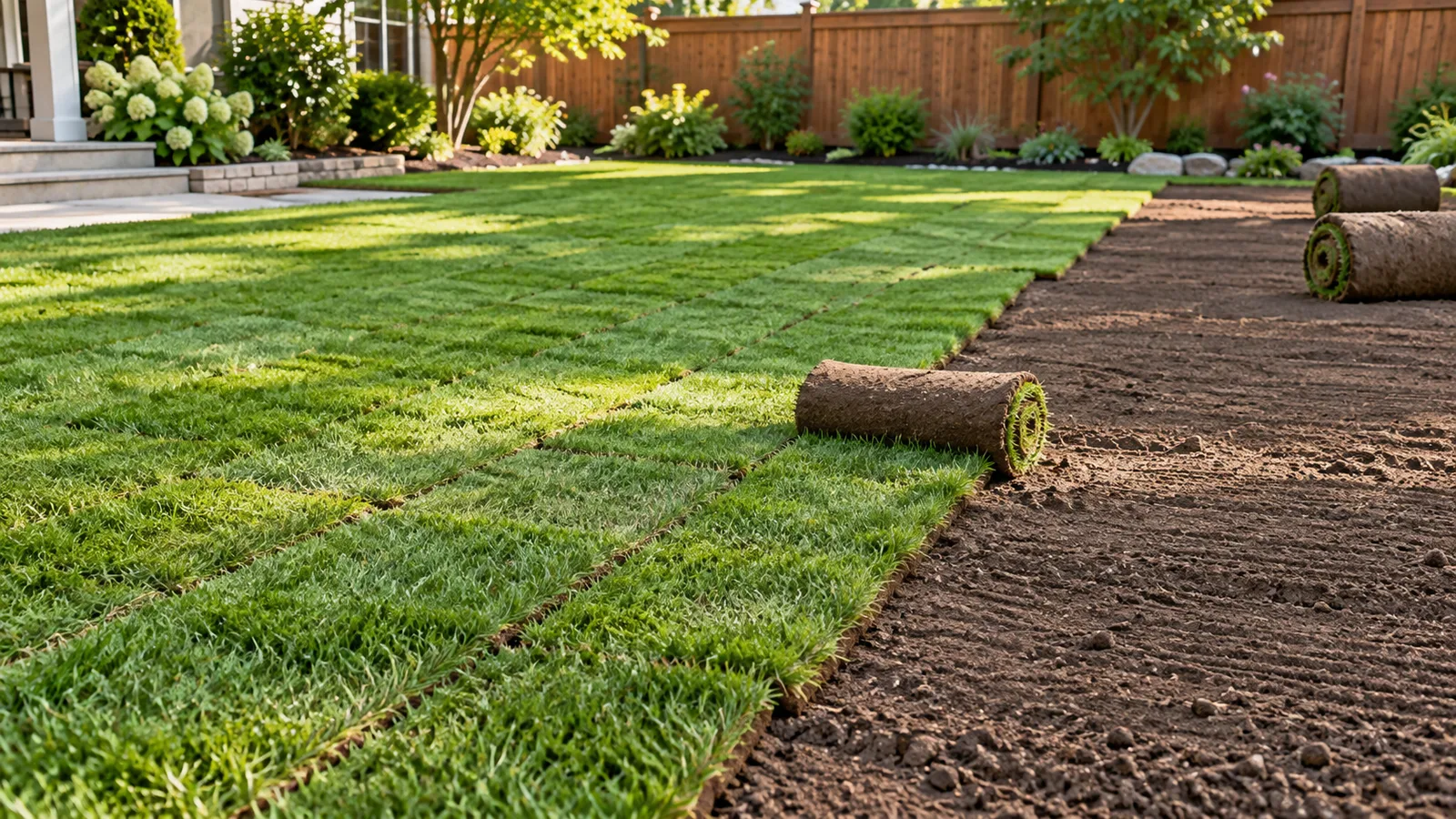
Sod gives a usable lawn within weeks and holds soil immediately, while seed costs less up front but needs a longer, carefully watered establishment period, which matters under local watering rules. That is a planning comparison, not a promise that every lawn will be ready on the same date. Sod covers the ground before its roots have grown into your soil. Seed needs time to germinate and fill in. Choose around the grass species, season, sun, slope and care you can provide. Before ordering either, work out how to establish the lawn within your water supplier’s rules. Landscape Associates of CA installs natural sod and provides free on-site estimates for homeowners weighing their lawn options.
Sod vs seed at a glance
In brief: Sod gives a usable lawn within weeks and holds soil immediately, while seed costs less up front but needs a longer, carefully watered establishment period, which matters under local watering rules. Surface cover is immediate; rooting and readiness for regular use still need checking.
| Factor | Sod | Seed |
|---|---|---|
| Time to a usable lawn | Generally sooner; rooted condition determines use | Longer; germination is only the beginning |
| Establishment watering | Keep turf and underlying soil appropriately moist | Protect the seedbed from drying during germination |
| Erosion on slopes | Immediate cover can help protect soil | Seed can wash away before establishment |
| Weeds | Fewer early invasions; still needs care | More vulnerable while filling in |
| Grass choice | Choose among suitable available sod products | Broader choice, but some grasses cannot be seeded |
| Season | More flexible; favor the species’ active growing period | Cool-season and warm-season seed need different windows |
| Upfront cost | Higher | Lower |
Sources: UC IPM’s planting-method comparison, new-lawn irrigation guidance and seed planting guidance; grass-choice comparison also reflects Illinois Extension.
Ask what “ready” means in any estimate. First roots, a first mowing and a lawn that can take regular play are different milestones. Plan another route for people and pets while the new surface develops.
When seed makes sense
In brief: Seed makes sense when a lower initial outlay matters, the grass you want is available as seed, and you can protect the area while it develops. Choose the planting window for that grass rather than treating every Bay Area lawn as an identical fall project.
UC’s California seeding guidance favors September and October for cool-season grasses, with March and April as the next choice. Seedable warm-season grasses belong in a warmer spring window. Confirm the species on the bag before planning around a calendar.
Start with the conditions in your yard. UC’s species-selection guidance considers sun and shade, temperature, wear and available water. A cheaper bag is not a useful saving if its grass is poorly suited to the spot.
Make an honest care plan: who will check the seedbed, keep traffic off it and watch for weeds? If nobody can do that during your planned planting period, reconsider the timing. Buying seed commits you to more than spreading it across bare dirt.
When sod makes sense
In brief: Sod makes sense when you want ground coverage sooner and can pay more at the start. It can also help where exposed soil is vulnerable to erosion. Choose a suitable grass and installation season, then protect the new lawn until roots connect it to the prepared soil.
UC’s sod guidance favors active growth: early fall or early spring for cool-season grasses, and mid-to-late spring for warm-season grasses. Although installation is possible more broadly, avoid very hot or very cold conditions where possible.
Arrange delivery around a finished planting bed, not the other way around. UC recommends installing sod promptly. Its installation instructions use staggered ends and a level surface. A green roll does not remove the need for careful fitting and soil contact.
For a sloping yard, ask how the proposed lawn will stay in place while rooting. Ground cover and drainage design are separate questions. Do not buy sod on the assumption that it resolves every hillside problem.
Watering a new lawn under local rules
In brief: Before choosing sod or seed, confirm that you can provide establishment care within the rules for your address. Both methods need attention to moisture. Start with your water supplier, the irrigation equipment and the planting season, rather than copying a generic daily schedule from a lawn label.
For properties on Valley Water-supplied potable water, Valley Water Ordinance 23-02 prohibits overhead irrigation from 9 AM to 6 PM and more than incidental runoff (checked October 2026).
UC’s new-lawn guidance emphasizes even coverage and avoiding saturation. Seedlings are vulnerable when the seedbed dries during germination. Sod also needs moisture below the turf, where new roots must grow. Neither method comes with a universal controller setting.
Before planting, identify dry corners, overspray and places where water collects. Discuss irrigation systems alongside the lawn choice. If the proposed care plan cannot work within applicable restrictions, change the planting plan before the materials arrive.
Soil prep matters more than the choice
In brief: Neither sod nor seed is a shortcut around preparing the planting bed. Clear debris and weeds, address drainage and grade, and finish irrigation work before the final surface is prepared. Base any soil additions on the site’s needs instead of buying the same amendment for every yard.
UC recommends checking soil characteristics to identify what, if anything, needs adding. That is especially useful when you do not know what lies beneath an old lawn or a recently built patio edge.
Its soil-preparation guidance calls for cultivation, weed control, removal of construction debris and grading away from buildings. Irrigation goes in before final grading. Look for low spots before covering the surface, when correcting them is easier to plan.
Keep preparation visible in the scope you compare. Ask whether removal, soil work, irrigation changes and disposal are included. Comparing only the grass material leaves out decisions that both methods depend on.
Real lawn or artificial turf?
In brief: Decide whether you want living grass before comparing its installation methods. Sod and seed are routes to a real lawn; artificial turf is a different surface with its own care and site considerations. Keep that decision separate from choosing the quickest way to cover bare soil.
For a side-by-side service overview, see real and artificial turf. If you are also budgeting for a synthetic surface, read about artificial turf cost in San Jose. Those artificial-turf figures are not sod or seed prices.
How we approach a new lawn
In brief: We recommend bringing the whole lawn question to the site visit: what the area is for, which parts receive sun, what irrigation is there and how soon you hope to use it. Those details make a more useful starting point than choosing sod simply because it looks finished.
Landscape Associates of CA installs natural sod. David Muhoberac works with homeowners on the yard layout, and projects receive an itemized price. Use the free on-site estimate to discuss preparation, irrigation and the care the new lawn will need. Tell us about pets, access and any planned gathering before settling on a planting date.
Frequently asked questions
Is sod or seed better for a new lawn?
Sod is the better fit when earlier coverage matters; seed may suit a lower initial budget and a more flexible timetable. Neither choice fixes an unsuitable grass selection or an unprepared planting bed. Decide how the lawn will be used, check sun and shade, and work out who will care for it during establishment. Then compare the complete job rather than the material alone.
How long does it take sod to root?
UC IPM gives about 10 to 14 days as general guidance for sod to become well rooted, not a guaranteed opening date for the yard. Its broader establishment guidance uses 2 to 3 weeks. Weather, species and care matter. Check that the sod has attached to the soil and ask your installer about use; a green surface alone does not establish readiness for regular play.
When is the best time to seed a lawn in the Bay Area?
The best window depends on whether you are planting a cool-season or warm-season grass. UC IPM favors September and October for cool-season seed, with March and April as the next choice. Seedable warm-season grasses need a warmer spring window. Identify the species first, then consider local conditions and your ability to provide establishment care. Do not apply a fall recommendation to every grass.
How often do you water new sod?
New sod needs a site-specific watering plan that keeps it and the underlying soil appropriately moist without saturation. There is no single frequency suitable for every yard. Check moisture and coverage rather than assuming green blades mean the roots have enough water. Ask for a plan suited to the weather, soil and irrigation equipment, and confirm the applicable water-supplier rules before setting the controller.
Is sod more expensive than seed?
Sod generally has a higher upfront cost than seed, as the UC planting-method comparison explains. That relative comparison is not a quote for your property. Ask for a scope that separates preparation, grass materials, installation and irrigation work, and consider the attention the lawn will need afterward. A useful comparison covers the same area and tasks rather than comparing a bag of seed with a finished installation.
Can you lay sod on a slope?
Sod can be used on slopes and can help protect exposed soil from erosion, but it still needs proper installation and establishment care. Do not treat it as a substitute for assessing drainage or the stability of the slope itself. Ask how the pieces will be installed, kept in contact with the soil and protected while rooting. Consider whether a lawn is practical for that particular area.
FAQ sources: UC IPM’s sod-rooting guidance, grass-development overview and the UC planting, irrigation and species guides linked above. These are general guides, not an inspection of your lawn.
Planning a new lawn?
In brief: Bring your lawn plans to Landscape Associates of CA for a free on-site estimate. Explain how you want to use the area and what timing you have in mind, so the conversation can cover the lawn, preparation and irrigation together before you commit to an installation.
Call or text (408) 207-5545, email david@landscapeassociatesca.com, or get a free on-site estimate. We reply within 24 hours.
Get in Touch
Call us, send the estimate form, or email us. We reply within 24 hours to book a free site visit. Call or text (408) 207-5545.
- (408) 207-5545
- Text (408) 207-5545
- david@landscapeassociatesca.com
- Mailing address: 125 Surf Way #443, Monterey, CA 93940
- Mon - Fri: 8:00-5:00 · Closed on weekends