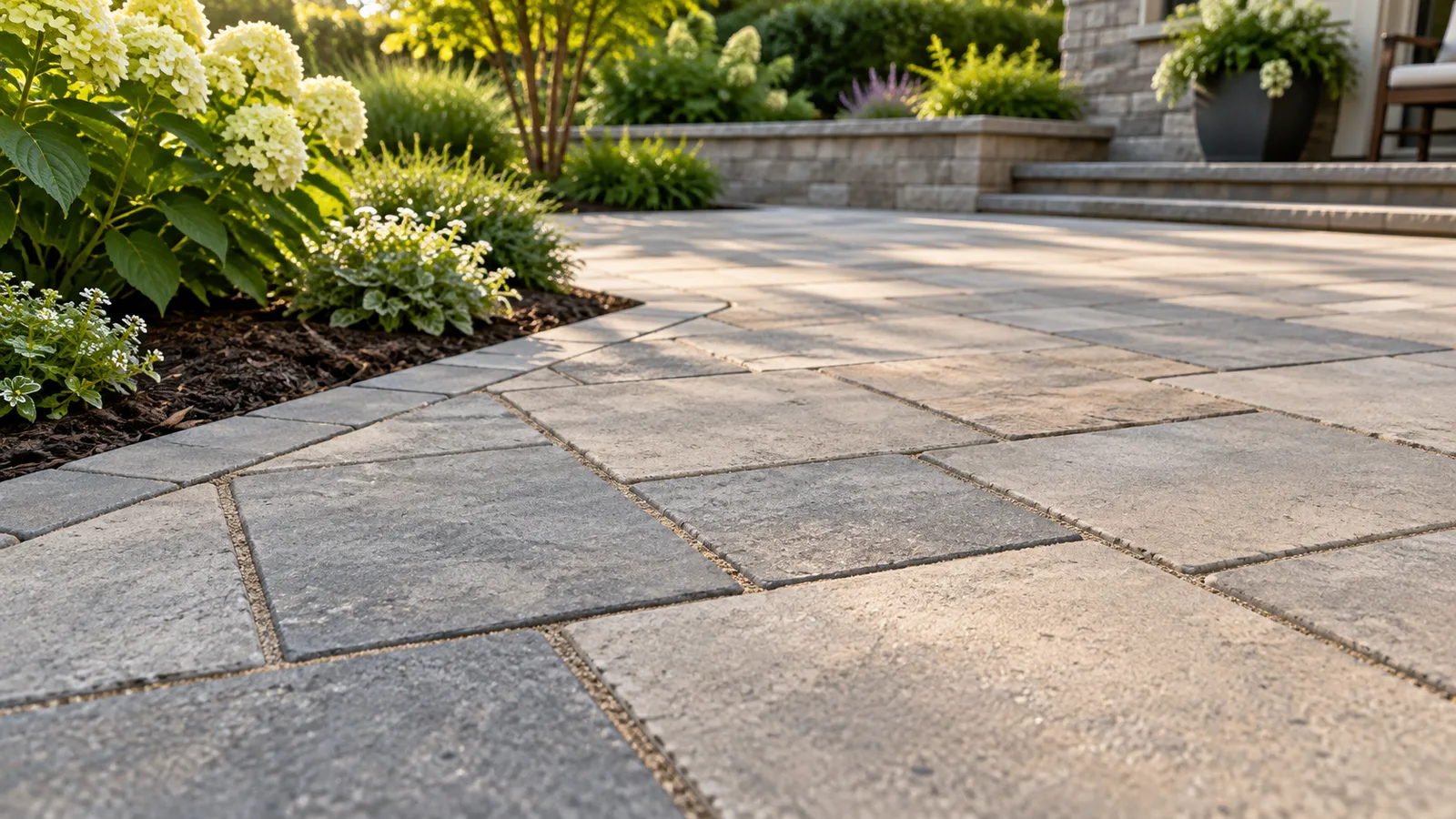
What paver sealer does
In brief: Paver sealer adds surface protection and can change appearance, but the result depends on the material you apply. Belgard describes stain protection and protection from color fading; Techo-Bloc describes easier cleaning and color enhancement. Choose by the benefit you need and the paver manufacturer’s care instructions.
Belgard’s sealing blog distinguishes film-forming finishes, which create a surface barrier and can be glossy, from non-film-forming matte finishes. A matte finish is worth discussing if you dislike shine, but ask to see the intended result before committing.
The manufacturers do not give identical advice. Techo-Bloc’s general FAQ describes sealing as optional. Its technologies page says requirements vary by surface. Belgard’s sealing blog recommends sealing all concrete pavers. Read those as brand guidance, not interchangeable instructions.
We suggest writing down your goal first: easier cleanup, a different appearance, or meeting the product’s care requirements. If your only reason is that someone said every patio needs another coat, identify the paver and existing treatment before deciding.
Seal or skip: a decision guide
In brief: The right call depends on what you want the sealer to do, where the pavers sit and what the product’s care instructions require. Use the situations below to frame the decision.
| Situation | Seal? | Why |
|---|---|---|
| Pool deck or outdoor kitchen with grease and spills | consider a compatible treatment | Stain protection can help around food; pool areas also need a wet-traction check. Choose for the actual exposure and surface. |
| Driveway with oil drips | consider, after checking oil resistance | Water repellency alone does not establish petroleum-stain protection. Confirm the intended protection with the supplier. |
| Wet or shaded area with persistent moss | investigate moisture first | Techo-Bloc advises professional help with moisture that encourages recurring moss. Do not treat sealing as a moss cure. |
| Patio whose original look you want to keep | check care requirements before skipping | Techo-Bloc’s guidance varies by surface; Belgard recommends sealing. Ask about compatible matte finishes and test the appearance. |
| New pavers | wait for the applicable instructions | Techo-Bloc and Belgard publish different waits. Identify the paver and sealer rather than choosing the shortest published interval. |
Sources: the Belgard and Techo-Bloc guidance linked above, plus CMHA’s cleaning and sealing technical note. The recommendations are a decision aid, not product application instructions.
For patios beside outdoor kitchens, describe where cooking and eating happen when discussing protection. For a driveway, identify the actual stain concern. These questions give the supplier something more useful than a request for the strongest sealer.
When to seal new pavers
In brief: There is no single waiting period for new pavers. Techo-Bloc’s general FAQ recommends at least one year. Belgard’s sealing blog distinguishes one week for non-film-forming sealers from 30 days for film-forming sealers, while its maintenance page says at least 30 days. Follow your paver and sealer instructions.
Techo-Bloc connects its wait to curing and allowing initial efflorescence to weather off. Belgard’s maintenance page connects its wait to removing efflorescence that may appear after installation. These are the manufacturers’ stated recommendations, checked October 2026, not a schedule for every brand.
Do not pick one week simply because it is the earliest number. Ask the supplier which guidance applies to your exact paver, sealer and installation. If the instructions appear to conflict, get that resolved before booking the application. Keep the answer with your project paperwork.
Our suggested checklist is simple: identify the paver, identify the proposed finish, find both care documents, and ask how the actual surface condition affects readiness. A date on the calendar should not replace those checks.
How often to reseal
In brief: There is no universal resealing interval. Belgard’s sealing blog offers three to five years as a rule of thumb, but its maintenance page also warns against excessive applications. Follow the sealer manufacturer’s label and confirm what the existing finish needs before adding another coat.
Belgard’s maintenance page advises spacing applications by at least three years and states a maximum of two applications. That qualification is easy to miss if you read only its general renewal recommendation. Do not turn the rule of thumb into an indefinite automatic recoating schedule.
We recommend keeping the product name, application date and care instructions together. When the patio looks different, describe the change to the supplier before deciding to reseal. Ask whether the next step is cleaning, another compatible treatment or further assessment. Avoid buying a replacement product solely because its finish sounds similar.
Cleaning before sealing, and common mistakes
In brief: Preparation and compatibility matter as much as the finish. CMHA calls for removing stains, dirt and efflorescence before sealing, and says most sealers need a completely dry surface. Follow the product’s instructions, including safety precautions, rather than using a generic cleaning or coating recipe.
Belgard recommends testing cleaners in an inconspicuous area and warns that pressure washing can expose aggregate. We suggest asking the person doing the work how they will test the treatment and protect nearby surfaces before the job begins.
- Do not assume a stain will disappear under a new finish. Address it before treatment.
- Do not add extra sealer for reassurance. Excess application can create appearance and traction problems.
- Do not ignore damp joints or poor drainage. CMHA identifies moisture and excessive thickness as possible causes of cloudiness.
- Do not improvise chemical mixtures. Use the selected product’s label and safety information.
This is a planning guide, not a mixing, spraying or pressure-washing tutorial. If you cannot identify an existing treatment, make compatibility the first question for the supplier. Keep children, pets and foot traffic out of the work area as required by the product’s instructions.
How we approach it
In brief: We recommend starting with your paver product, its care instructions and the result you want, then comparing the treatment choices. Keep installation questions separate from finish preferences. A conversation about maintenance should also cover what is already on the surface and whether you want its appearance to change.
Landscape Associates of CA provides paver patios and driveways, with a lifetime paver warranty covering materials and workmanship. Ask us about your project and the care information for the selected pavers. For installation planning, see our guide to paver patio cost in San Jose.
Frequently asked questions
In brief: The best answer starts with the exact paver and treatment, especially when care pages give different advice. The questions below separate manufacturer recommendations from general maintenance decisions. Use them to prepare for a supplier conversation rather than treating any single answer as instructions for every patio.
Do pavers need to be sealed?
Some do, and some do not: check the specific product’s care instructions. Techo-Bloc’s general FAQ calls sealing optional, while its technologies page says requirements vary by surface. Belgard recommends sealing its concrete pavers. We suggest identifying your paver before deciding, then comparing the desired appearance and protection with the care requirements. Another patio’s maintenance plan is not enough information to choose yours.
How long should you wait to seal new pavers?
Use the waiting period for your paver and chosen sealer, not a universal number. Techo-Bloc’s general FAQ recommends at least one year. Belgard’s sealing blog gives one week for non-film-forming sealers and 30 days for film-forming sealers; its maintenance page says at least 30 days. Ask the supplier to resolve which instructions apply before scheduling work, and do not assume the shortest interval fits your installation.
How often should pavers be resealed?
Reseal according to the product’s instructions and condition rather than an automatic calendar. Belgard’s blog gives three to five years as a rule of thumb, while its maintenance page also limits application frequency and number. We recommend saving the original treatment details so you can ask a useful question when the surface changes. Confirm the next appropriate maintenance step before purchasing or applying another coating.
Does sealing pavers make them slippery?
Sealing can create a slippery surface if the product or application is unsuitable. CMHA warns about overapplication and recommends checking wet and dry slip-resistance characteristics with the manufacturer. For a pool deck or frequently wet walkway, make traction an explicit part of product selection. Ask how the proposed treatment suits that use rather than choosing by shine alone, and follow the application instructions.
Does sealing stop weeds between pavers?
Do not expect sealing to make paver joints permanently weed-free. CMHA describes reduced weed potential, while Techo-Bloc acknowledges that growth between pavers is possible. For persistent moss in damp shade, Techo-Bloc recommends professional advice about the underlying moisture. We suggest describing whether you are seeing weeds, moss or another surface problem before buying a treatment, so the proposed maintenance addresses the concern you actually have.
Can you seal pavers yourself?
DIY suitability depends on the product, the surface and whether you can follow all preparation and safety instructions. Read the label and safety data before deciding. We suggest getting professional help when the existing finish is unknown, the surface has unresolved staining or moisture, or the required precautions are unclear. Do not improvise application rates or cleanup methods from a general article; resolve those details with the product supplier.
Questions about your pavers?
For help planning a paver project, call or text Landscape Associates of CA at (408) 207-5545, or email david@landscapeassociatesca.com. You can also get a free on-site estimate through our contact page. We reply within 24 hours; bring your questions about appearance, use and maintenance.
Get in Touch
Call us, send the estimate form, or email us. We reply within 24 hours to book a free site visit. Call or text (408) 207-5545.
- (408) 207-5545
- Text (408) 207-5545
- david@landscapeassociatesca.com
- Mailing address: 125 Surf Way #443, Monterey, CA 93940
- Mon - Fri: 8:00-5:00 · Closed on weekends