By David Muhoberac
Last updated: November 2026
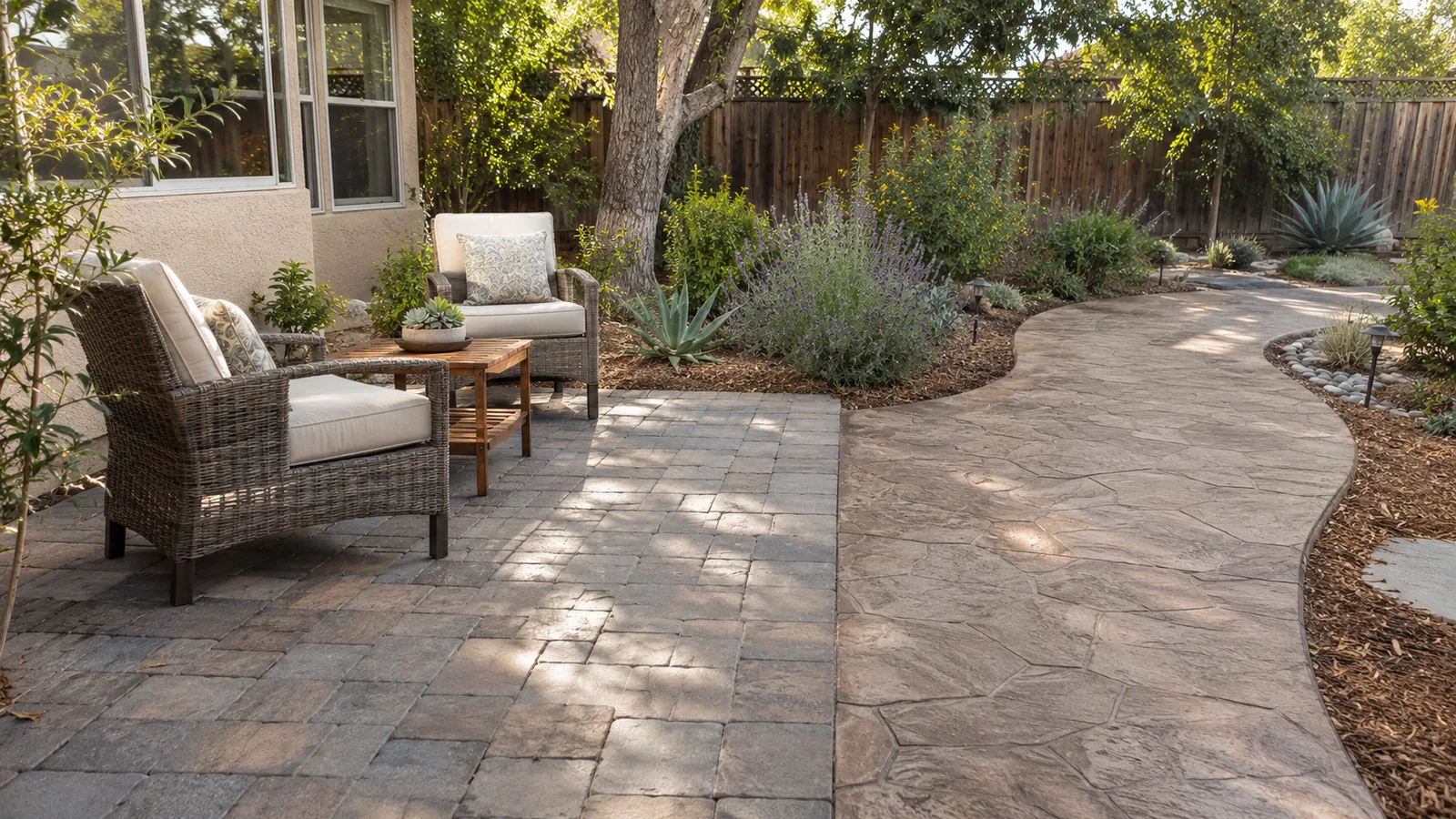
Pavers and stamped concrete can look similar on day one, but pavers are separate units that flex with the ground and can be replaced one at a time, while stamped concrete is one slab that relies on control joints to manage cracking.
Choose pavers when local repairs are a priority; consider stamped concrete when you prefer a patterned slab. Neither choice removes the need for suitable ground preparation. Landscape Associates of CA installs both and offers a free on-site estimate to compare them for your yard.
How stamped concrete and pavers are built
Stamped concrete gets its pattern while the poured material is still workable. Interlocking concrete pavers arrive as separate manufactured pieces and are assembled over a prepared base. That difference matters beyond appearance: the slab needs a joint layout and curing, while the paver surface depends on its base, joints and supported edges.
A stamped finish can imitate stone or other materials, but the pattern does not turn the concrete into separate stones. Ask to see where the control joints will fall within the design. A joint across a favorite pattern is something to understand before the pour, not discover afterward.
With pavers, the seams are part of the layout. Colors, shapes and laying patterns give you choices, including contrasting borders. Techo-Bloc’s comparison explains these construction and appearance differences. Compare samples at your house and decide whether you prefer the repeated units or the stamped surface.
Curing also deserves a place in the plan. The American Concrete Institute’s curing guidance describes managing moisture and temperature so the concrete can develop its properties. A surface that looks dry is not, by itself, permission to put it into service.
Stamped concrete vs pavers, side by side
The useful comparison is how each surface will be built, maintained and repaired in your yard. A damaged paver can be exchanged individually; a damaged stamped slab needs a repair suited to the concrete and its finish. Compare those practical differences alongside the pattern, the schedule and the written quote.
| Factor | Stamped concrete | Pavers |
|---|---|---|
| Look and patterns | Pattern and color applied to a poured slab; control joints remain part of the layout. | Individual units in different colors, shapes and patterns; seams form part of the design. |
| Cracking | Can crack. Control joints guide crack location but do not eliminate the possibility of other cracks. | Joints accommodate slight movement. Individual units can still crack, settle or shift. |
| Repairs | May require patching or section replacement; matching the existing finish can be difficult. | Damaged pieces can be replaced; a settled area can be lifted for base adjustment and resetting. |
| Installation time | Scheduled by project. Allow for preparation, placement and the subsequent curing period. | Most San Jose paver patios take 3 to 7 days, depending on size, pattern and preparation. |
| Curing before use | Company guidance: setting window of 24 to 48 hours; light foot traffic after about 3 days; keep vehicles off for 7 days. Confirm the timing for your project. | Manufactured units begin curing before installation. Ask when the completed pavement and its joint materials are ready for use. |
| Upkeep | Plan for cleaning and finish-specific sealing care. | Keep the surface clean and maintain joint sand. Sealing depends on the selected product and care instructions. |
| Warranty | No warranty stated. | Company lifetime warranty covering materials and workmanship. |
| Cost | Quoted per project. | San Jose paver patios: about $15 to $30 per square foot installed. |
Sources: company paver patios and driveways and concrete work pages; CMHA maintenance guidance; Techo-Bloc’s comparison linked above; ACI slab guidance linked below.
The familiar 28-day number is a strength benchmark, not a universal full-cure deadline. The American Cement Association explains that compressive strength is conventionally measured at 28 days. Keep that separate from the date you can walk on a patio or return a car to a driveway.
For patio budgeting, start with the paver patio cost in San Jose guide. We do not publish a stamped-concrete price, so we do not claim that either surface saves you money. For maintenance, read should you seal pavers before assuming every paver needs the same treatment.
Cracking and repairs on clay soil
On expansive clay, the ground can change volume as moisture changes, so the surface choice cannot replace suitable preparation. Pavers offer an advantage when an affected area needs lifting and resetting. Stamped concrete remains an option, but its joint plan and the appearance of possible repairs deserve attention before installation.
UC Master Gardeners of Santa Clara County identifies clay as dominant locally. That does not establish the soil conditions of every property. The Colorado Geological Survey explains the relevant mechanism: expansive clay-bearing material swells when wetted and shrinks as it dries.
The Concrete Masonry & Hardscapes Association’s comparison describes how a paver system accommodates slight ground movement. Its maintenance guide also documents settlement and cracked units. If a section sinks, simply putting the pieces back at the old height is not the whole repair; the underlying cause needs attention.
Concrete joints serve a different purpose. ACI’s floor and slab guide describes saw cuts as weakened planes that encourage cracks beneath them, while acknowledging that random cracking can still occur. Ask about repair options before choosing a highly patterned finish, especially if a visible patch would bother you.
Which suits a patio, a walkway or a driveway
For a patio, start with the appearance you want and how much repair flexibility matters to you. For a walkway, compare the proposed layout and finish along the actual route. For a driveway, ask for a design and quote that address vehicle use rather than borrowing the assumptions of a patio.
- Patio: favor pavers if replacing a damaged piece is a major priority. Consider stamped concrete if you prefer its pattern and accept the joint layout and potential repair visibility.
- Walkway: ask to see how each choice meets adjoining surfaces. Review samples and the placement of seams or control joints before choosing by color alone.
- Driveway: request product and base details appropriate to vehicles. Neither a patio price nor a photograph establishes that an installation is suitable for your driveway.
Put your priorities in order before requesting alternatives. If you care most about a particular stamped finish, say so. If keeping future repairs local matters more, make that clear. The better choice is the one whose trade-offs you understand and accept.
How we approach the choice
A useful estimate compares the same area and intended use, with preparation, finish and access considered together. Ask for both options on that basis before choosing a surface. The questions are practical: what will be built underneath, when can you use it, and how would a damaged section be repaired?
At Landscape Associates of CA, we offer both paver patios and driveways and concrete work, with a free on-site estimate and itemized project pricing. Bring your preferred patterns and tell us how you want to use the space. We can discuss the choice without treating one material as the answer to every yard.
Frequently asked questions
The questions below separate what can be compared now from what needs a project quote. Repair methods and published company guidance give you a starting point. Exact pricing, readiness for use and the right construction for your soil should be settled for the proposed installation, not assumed from another homeowner’s patio.
Is stamped concrete cheaper than pavers?
Do pavers last longer than stamped concrete?
Does stamped concrete crack?
Can you replace one damaged paver?
How long before you can walk on a new concrete patio?
Which is better on clay soil, pavers or stamped concrete?
Choosing between pavers and concrete?
Ask Landscape Associates of CA to compare both choices for your yard. Call or text (408) 207-5545, email david@landscapeassociatesca.com, or get a free on-site estimate. We reply within 24 hours. Tell us whether you are planning a patio, walkway or driveway, and which trade-offs matter most to you.
Get in Touch
Call us, send the estimate form, or email us. We reply within 24 hours to book a free site visit. Call or text (408) 207-5545.
- (408) 207-5545
- Text (408) 207-5545
- david@landscapeassociatesca.com
- Mailing address: 125 Surf Way #443, Monterey, CA 93940
- Mon - Fri: 8:00-5:00 · Closed on weekends