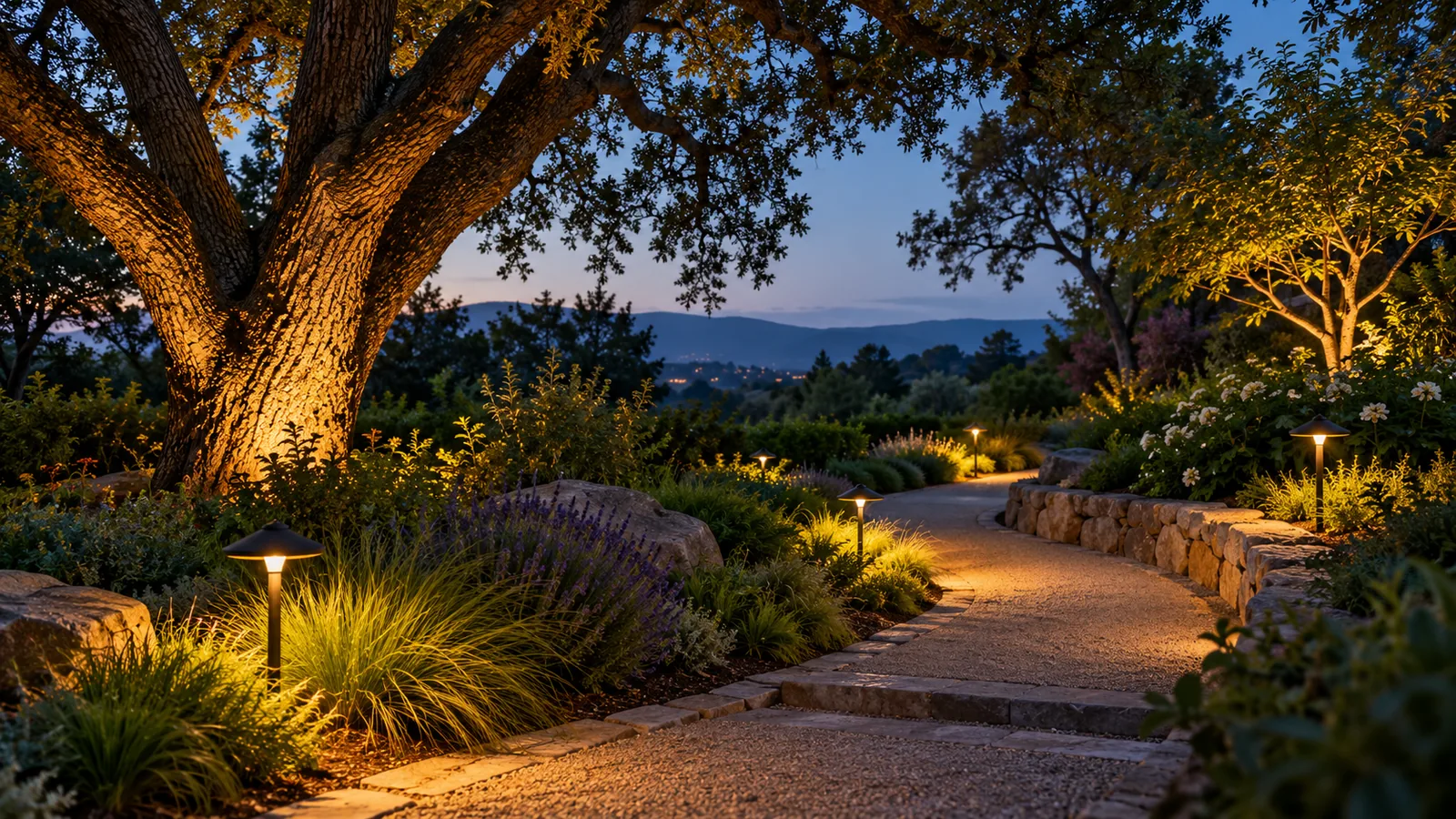
How solar landscape lights work
Solar landscape lights collect energy through a panel, store it in a rechargeable battery and use it to power a light after dark. Many models use a daylight sensor to switch on automatically. Their usefulness depends on the sunlight reaching the panel and the demands of the selected lighting mode.
A panel on top of a fixture makes placement especially important: the spot where you want light also needs to suit charging. Before choosing a solar light, read its sunlight requirements and find out whether the battery is replaceable. A sunny-looking yard is not enough if the proposed fixture sits beneath foliage.
VOLT’s solar-lighting guidance explains how panels, batteries and dusk sensors work together, and why partial shade can shorten performance. It also describes adjustable brightness on select models. Those features vary, so check the specific product rather than applying one model’s promises to every solar light.
How low-voltage lighting works
Low-voltage landscape lighting uses a transformer to reduce household supply voltage before sending power through cables to compatible fixtures. A typical system uses 12-volt lights, although equipment specifications vary. Because its supply comes from the home, the panel-charging conditions that affect a solar fixture do not determine its nightly operation.
VOLT’s transformer guidance describes conversion from household power to low voltage and lists timer and photocell options. The transformer, cable layout and fixtures need to be selected together. This is not a promise that any lamp can connect to any transformer.
Controls also need matching equipment. FX Luminaire’s Luxor documentation describes programmed groups and dimming; its color-control guidance requires specific compatible LED boards. Ask which functions are included in your proposed system. Low-voltage lighting still depends on a working power supply and maintained equipment.
Solar vs low-voltage, side by side
Solar landscape lights only work as well as the sun their panels receive, so in a yard shaded by trees or buildings low-voltage lighting, powered from a transformer, is usually the more reliable choice. The comparison below separates the power source from product-specific features and installation choices.
| Factor | Solar | Low-voltage |
|---|---|---|
| Power source | Panel charges a battery that supplies the light. | Household power feeds a transformer and wired fixtures. |
| Performance in shade | Shading the panel can limit charging and useful nighttime performance. | Power supply does not depend on sunlight at the fixture. |
| Brightness and color control | Output, color and high/low settings vary by product and available charge. | Choose fixture output and light color; dimming or color changes require compatible equipment. |
| Timers and smart control | Automatic dusk sensing is available; check the model for other controls. | Timers, photocells and app control are options, depending on the system. |
| Installation | Self-contained models avoid supply wiring but need a suitable charging location. | Requires transformer placement, cable routes and fixture connections. |
| Upkeep | Keep panels clear; check batteries and follow the product’s maintenance instructions. | Plan for fixture cleaning and checks of wiring, connections and controls. |
| Warranty | Varies by product. | Landscape Associates of CA’s lighting warranty is 2 years. |
Sources: the manufacturer guidance linked above, VOLT’s solar fixture specifications, VOLT’s maintenance guidance, and Landscape Associates of CA’s published lighting service information. Features are model-dependent; the company warranty is not a comparison of manufacturer warranties.
Why shade changes the answer
Shade changes the choice because the solar panel needs a suitable charging location, while a wired fixture needs a suitable lighting location. Those may not be the same place. Check the actual panel position through the day, especially beside north-facing walls, beneath trees and where buildings interrupt the available sun.
The U.S. Department of Energy explains that sunlight at a location varies with season, landscape and weather. Winter also brings shorter days and a lower sun angle. A summer observation alone is therefore a weak basis for choosing a light you want to use year-round.
Walk the route you want illuminated and mark the proposed panel positions. Is each one genuinely exposed, or does an overhang shade it? If charging placement conflicts with the path layout, compare low-voltage lighting before buying fixtures. Some solar models have a separate panel that can sit in a sunnier location while the light serves a shaded area. Check the cable reach and charging requirements. This is a site-specific decision, not a claim that solar cannot work anywhere in a partly shaded garden.
What low-voltage lighting costs
Landscape Associates of CA’s published lighting ranges are $2,000 to $6,000 for San Jose installations and $3,000 to $10,000 for larger Saratoga properties. Treat those figures as planning ranges for the company’s work, not fixed quotes or a universal price for every yard. The actual project needs an itemized estimate.
Compare estimates for the same areas and controls. Ask what fixtures, transformer, wiring and installation are included, and whether any new electrical supply work is separate. A price comparison means little if one proposal lights the entrance and another covers paths throughout the property.
For broader project context, see landscaping costs in San Jose and landscaping in Saratoga. Keep the lighting allowance distinct from other yard improvements so you can decide what to prioritize.
How we approach a lighting plan
A useful lighting plan starts with where people walk and what they need to see, then considers shade, fixture placement, controls and the power supply. Walk the yard during the estimate and identify your priorities before choosing equipment. Ask for the proposed scope and operating controls to be explained together.
We walk the yard with you at the free on-site estimate and discuss the paths, steps and areas you want lit. We install landscape lighting across San Jose, Saratoga, Los Gatos and the other cities on our locations page. We install Volt, FX Luminaire and Kichler low-voltage LED fixtures. Our outdoor and landscape lighting service page explains the approach and the 2-year lighting warranty. Any new outlet is an electrician’s job.
Follow the selected equipment’s installation instructions and applicable requirements; low voltage is not a blanket safety or permit exemption. VOLT’s installation guidance directs readers to check national and local electrical requirements. This comparison is a planning guide, not instructions for electrical work.
For properties subject to the Town of Los Gatos hillside lighting standards (checked October 2026), lighting must be low-level, downward and shielded without spill or glare onto neighbors. Purely decorative lighting and tree uplighting are prohibited. Confirm applicability with the Town before choosing a design; these are hillside standards, not a statement about every Los Gatos property.
Frequently asked questions
Do solar landscape lights work in the shade?
Solar landscape lights may operate in partial shade, but shaded panels can limit charging and nighttime performance. The answer depends on the particular light and the sunlight reaching its panel, not simply whether the yard feels bright. Check the manufacturer’s placement guidance and observe the proposed spot through the day. For a heavily shaded route that you use every evening, compare transformer-fed lighting before committing to solar fixtures.
Is low-voltage landscape lighting better than solar?
Low-voltage lighting is usually the stronger choice when shade limits solar charging or you want a coordinated wired layout. Solar can suit a sunny spot where a self-contained fixture meets your needs. Neither label alone tells you brightness, beam quality or available controls. Compare actual products, the areas you want lit and installation requirements. Dimming and phone control need compatible equipment; they are not automatic features of every low-voltage system.
How long do solar landscape lights last at night?
Solar landscape lights do not have one reliable runtime that applies to every product and yard. Nighttime operation depends on charging conditions, battery condition and the selected mode. A manufacturer’s stated performance needs to be read with its charging assumptions. Check the exact model’s instructions and assess it in the intended location. Do not treat a good result on a sunny day as proof of the same performance through shaded or overcast periods.
What does low-voltage mean for landscape lighting?
Low-voltage landscape lighting typically means fixtures supplied at about 12 volts through a transformer rather than connected directly to household line voltage. The transformer reduces the supply voltage, and cables carry power to compatible lights. Equipment specifications govern the actual setup. Low voltage does not remove the need for correct installation, suitable outdoor connections and maintenance. Any new outlet is an electrician’s job, separate from choosing where the landscape fixtures belong.
How much does landscape lighting cost in San Jose?
Landscape Associates of CA publishes a range of $2,000 to $6,000 for San Jose lighting installations. Its separate range for larger Saratoga properties is $3,000 to $10,000. These are company planning figures, not a fixed price for your yard or a solar-light comparison. Request an itemized estimate for the areas and controls you want, and confirm what equipment, wiring and installation are included before comparing proposals.
Can low-voltage lights be put on a timer?
Low-voltage landscape lights can be scheduled with a compatible timer or control system. Depending on the selected equipment, options may also include a photocell or app-based operation. Ask which controls are part of the proposed installation and whether they support the schedule you want. A simple on-and-off timer is different from dimming separate groups or changing colors, so confirm those capabilities rather than assuming every transformer provides them.
Planning landscape lighting?
Start with the paths and steps you want to use after dark, then compare a lighting plan against the shade and power supply at your property. Landscape Associates of CA offers a free on-site estimate and an itemized quote so you can review the proposed work before deciding.
Call or text (408) 207-5545, email david@landscapeassociatesca.com, or get a free on-site estimate. We reply within 24 hours.
Get in Touch
Call us, send the estimate form, or email us. We reply within 24 hours to book a free site visit. Call or text (408) 207-5545.
- (408) 207-5545
- Text (408) 207-5545
- david@landscapeassociatesca.com
- Mailing address: 125 Surf Way #443, Monterey, CA 93940
- Mon - Fri: 8:00-5:00 · Closed on weekends