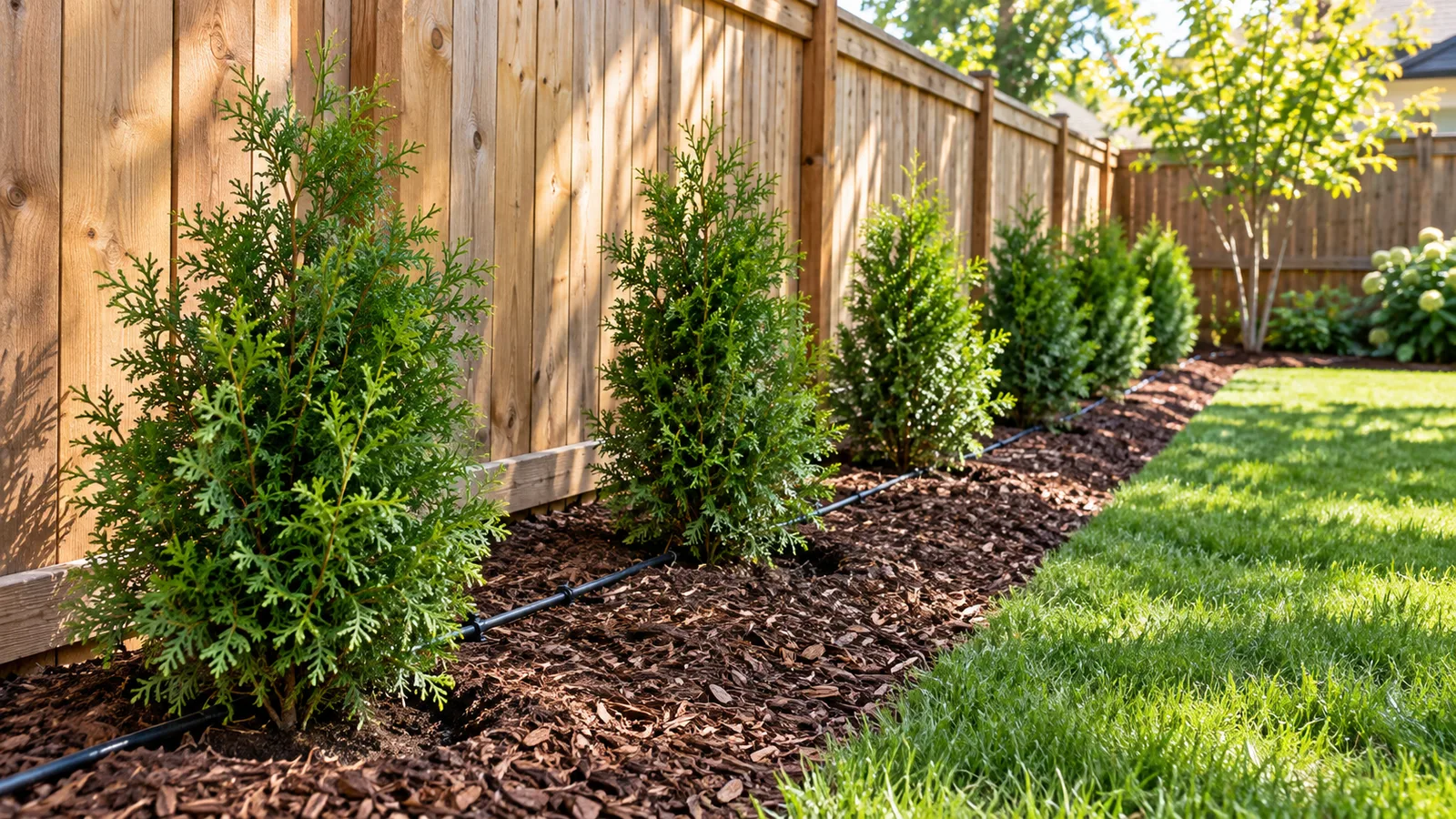
How far apart to plant a privacy hedge depends on the plant’s mature width, and spacing plants closer than the source guidance can give a faster screen at first but increases crowding, disease risk and pruning later. Start with the exact plant variety, its eventual width and the view you want to block. A shrub that fits the available bed is a better starting point than a promise of instant coverage. The table below separates verified plant dimensions from loose-screen layout baselines; it does not promise a finished hedge by a certain month. Allow for irrigation, access and pruning before buying. Landscape Associates of CA offers a free on-site estimate to plan a privacy planting with you.
How far apart to plant a privacy hedge
Base privacy hedge spacing on the selected plant’s mature width and its own spacing guidance, then decide how dense the screen needs to be. Measure between plant centers, not the edges of nursery pots. A single row usually makes the simplest layout to assess in a narrow bed.
UC Master Gardeners of Alameda County explain that mature size and spacing matter for room to grow and air circulation. There is no verified universal rule here that every hedge belongs three feet apart, or at half its mature width.
For a loose-screen starting layout, mark out the plant’s expected width between centers. This is a planning baseline, not a cultivar-specific dense-hedge prescription. Before tightening it, confirm the exact nursery selection and the pruning needed to keep it in bounds.
A staggered double row offsets plants behind the gaps in the first row. Draw both rows at mature size before choosing it: filling a view on paper is not useful if the resulting bed consumes your walkway. Keep a single row if two rows cannot fit comfortably.
Privacy hedge plants for South Bay yards
How far apart to plant a privacy hedge depends on the plant’s mature width, and spacing plants closer than the source guidance can give a faster screen at first but increases crowding, disease risk and pruning later. Use the verified dimensions below to compare fit before deciding how tightly to plant.
These are candidates to assess for your site, not a claim that every option suits a narrow side yard. Spacing below is an explicitly derived mature-width baseline for a loose screen. Published dimensions are estimates, not hard limits; confirm the cultivar and local conditions.
| Plant | Mature height and width | Spacing | Sun and water | Notes for narrow yards |
|---|---|---|---|---|
| ‘Mound San Bruno’ coffeeberry Frangula californica | About 5 feet tall and wide | About 5 feet on center as a mature-width baseline; confirm closer hedge spacing for this cultivar | Full sun or partial shade; little water once established | Dense evergreen form; compare its width with the usable bed. No fixed screening date. |
| Toyon Heteromeles arbutifolia | Usually 6 to 12 feet tall and wide in the cited hedgerow guide | 6 to 12 feet on center as a mature-width baseline; select a site-appropriate width before layout | Full sun to partial shade; tolerates dry summers, benefits from occasional irrigation | UC calls it fast-growing; that does not specify a screening date. Allow room for a substantial shrub. |
| ‘Ray Hartman’ ceanothus | 15 to 20 feet tall and wide | 15 to 20 feet on center as a mature-width baseline; requires a site-specific screen plan | Sun or part shade; UC Davis rates established irrigation needs low | A large-screen candidate where space allows, not a default for a tight side yard. No fixed screening date. |
Sources: UC Master Gardeners of Sonoma County on coffeeberry and native hedgerow plants; UC IPM on toyon; UC Davis Arboretum on ‘Ray Hartman’. Spacing baselines are derived from those widths, not quoted hedge recommendations.
Context matters: UC’s farm hedgerow publication uses 15-foot spacing for large shrubs in a mixed agricultural planting. That is useful evidence that purpose changes spacing, not a backyard recipe. For a dense residential hedge, obtain variety-specific guidance rather than copying an agricultural layout.
How long until a hedge gives real privacy
A hedge provides useful privacy when its foliage blocks your particular sightline, not when it reaches a label’s mature height. The sources here do not establish a reliable month count for these plants in San Jose. Assess starting height, width and density, then discuss the gaps still needing growth.
The Sonoma guide describes toyon as fast-growing. It does not say toyon is the fastest privacy hedge for San Jose, or promise how soon neighboring plants will touch. The verified coffeeberry and ‘Ray Hartman’ profiles likewise do not provide a completion schedule.
Nursery container size belongs in the discussion, but inspect the plant itself. Ask to compare actual foliage and root condition rather than buying by the pot label alone. A taller plant with an open lower section may leave the seated view exposed. If privacy is needed immediately, plan a separate screen while the planting develops.
Planting for clay soil and dry summers
A hedge in clay soil needs a plant suited to that soil and irrigation matched to drainage. Do not assume a dry surface means the root ball needs more water. Prepare the planting area, keep water from pooling at the crown and monitor moisture as roots establish beyond the nursery soil.
UC’s native-planting guidance recommends choosing clay-adapted natives where soil is heavy and letting soggy soil dry somewhat before planting. Backfill with the native soil. A mound may be an option where appropriate, but it is not a substitute for understanding where water will go.
Plan drip irrigation around the root zone. UC’s drip guidance distinguishes establishment watering from mature needs and recommends moving emitters outward as plants grow. Low-water does not mean a newly planted hedge can be ignored.
UC Marin’s planting guide recommends a 2- to 4-inch layer of organic mulch, kept 6 to 12 inches from tree and shrub bases. Install irrigation before adding mulch. Check that water reaches soil rather than just wetting the surface covering.
Narrow side yards: hedge, screen or fence?
Choose a hedge only if the mature planting leaves the access and growing space you need. A fence or built screen may answer an immediate sightline problem without waiting for growth. A mixed solution can reserve plants for the wider part of the yard and keep tight passages clear.
Stand at the kitchen window, patio chair and gate before deciding. Identify which view needs screening; screening the entire boundary may be unnecessary. Compare a planting with a fence or other landscape construction option rather than squeezing a broad shrub into the remaining strip.
Where wildfire exposure is a concern, a continuous hedge needs another look. UC Marin’s fire-smart guidance warns that rows of shrubs can carry fire. Seek site-specific guidance before making an uninterrupted planted boundary near structures.
How we approach a privacy planting
A useful privacy plan starts with the homeowner’s view, available space and willingness to maintain the planting. Choose plants and layout together before setting a schedule. October to November is our recommended planting window; the right day still depends on soil conditions, plant availability and a workable irrigation plan.
At Landscape Associates of CA, David lays out the yard with the homeowner as part of the free on-site estimate and itemized quote. Discuss plant and tree installation, compare drought-tolerant plants for San Jose, and review the wider plan for landscaping in San Jose. Bring your preferred screening height and a clear idea of the access you want to preserve.
Frequently asked questions
How far apart should privacy hedge plants be?
Space privacy hedge plants according to the exact variety’s mature width and verified planting guidance. The table’s center-to-center figures are mature-width baselines for loose screens, not instructions for every clipped hedge. Confirm a tighter layout with the nursery or your planting designer before buying. Also allow space between the finished foliage, the fence and your access route; along-row spacing alone does not tell you whether a hedge fits.
What is the fastest growing privacy hedge for San Jose?
The published plant profiles do not identify one fastest privacy hedge for San Jose. UC Master Gardeners describe toyon as fast-growing, but that is not a local ranking or a promised annual increase. Choose for the actual light, soil, available width and screening height. A plant that becomes too broad creates another problem even if it starts filling quickly. Ask about the exact selection rather than relying on a general speed label.
How long does it take a hedge to provide privacy?
There is no universal completion time for the plants in this guide. Privacy depends on the starting foliage, the gaps between plants and the height of the view you need to block. Compare actual nursery specimens and discuss establishment care before expecting a schedule. If you need a blocked view from the start, consider a separate fence or screen rather than treating future growth as immediate coverage.
Can you plant a hedge in clay soil?
Yes, provided the chosen plants suit the soil and the planting plan addresses drainage. UC’s native-planting guidance advises selecting clay-adapted plants where soil is heavy. Avoid planting into very soggy soil, and prevent water from collecting at the crown. Irrigation should respond to actual root-zone moisture rather than a fixed assumption about dry weather. Review the whole bed before adding a mound or changing the soil around individual plants.
When is the best time to plant a hedge in the Bay Area?
October to November is Landscape Associates of CA’s recommended planting window. UC guidance for California natives describes a broader window from October through late winter, when cooler conditions support establishment before heat returns. These are compatible recommendations, not a promise that any fall day is suitable. Wait if the soil is very soggy, check the selected plant’s needs and have irrigation ready to support the new roots when rain is insufficient.
Is a hedge or a fence better for privacy in a narrow yard?
A fence or built screen may fit better when the yard cannot accommodate the hedge’s mature width or you need immediate coverage. A hedge is worth considering when there is adequate growing room and you want a planted boundary. Compare both from the actual place you sit or stand, leaving access for maintenance. You may need screening in only one section rather than a continuous barrier along the whole yard.
Planning a privacy hedge?
Bring the view you want to screen and the space you can spare to a conversation with Landscape Associates of CA. Call or text (408) 207-5545, email david@landscapeassociatesca.com, or get a free on-site estimate. We reply within 24 hours and can discuss a planting that fits your yard.
Get in Touch
Call us, send the estimate form, or email us. We reply within 24 hours to book a free site visit. Call or text (408) 207-5545.
- (408) 207-5545
- Text (408) 207-5545
- david@landscapeassociatesca.com
- Mailing address: 125 Surf Way #443, Monterey, CA 93940
- Mon - Fri: 8:00-5:00 · Closed on weekends