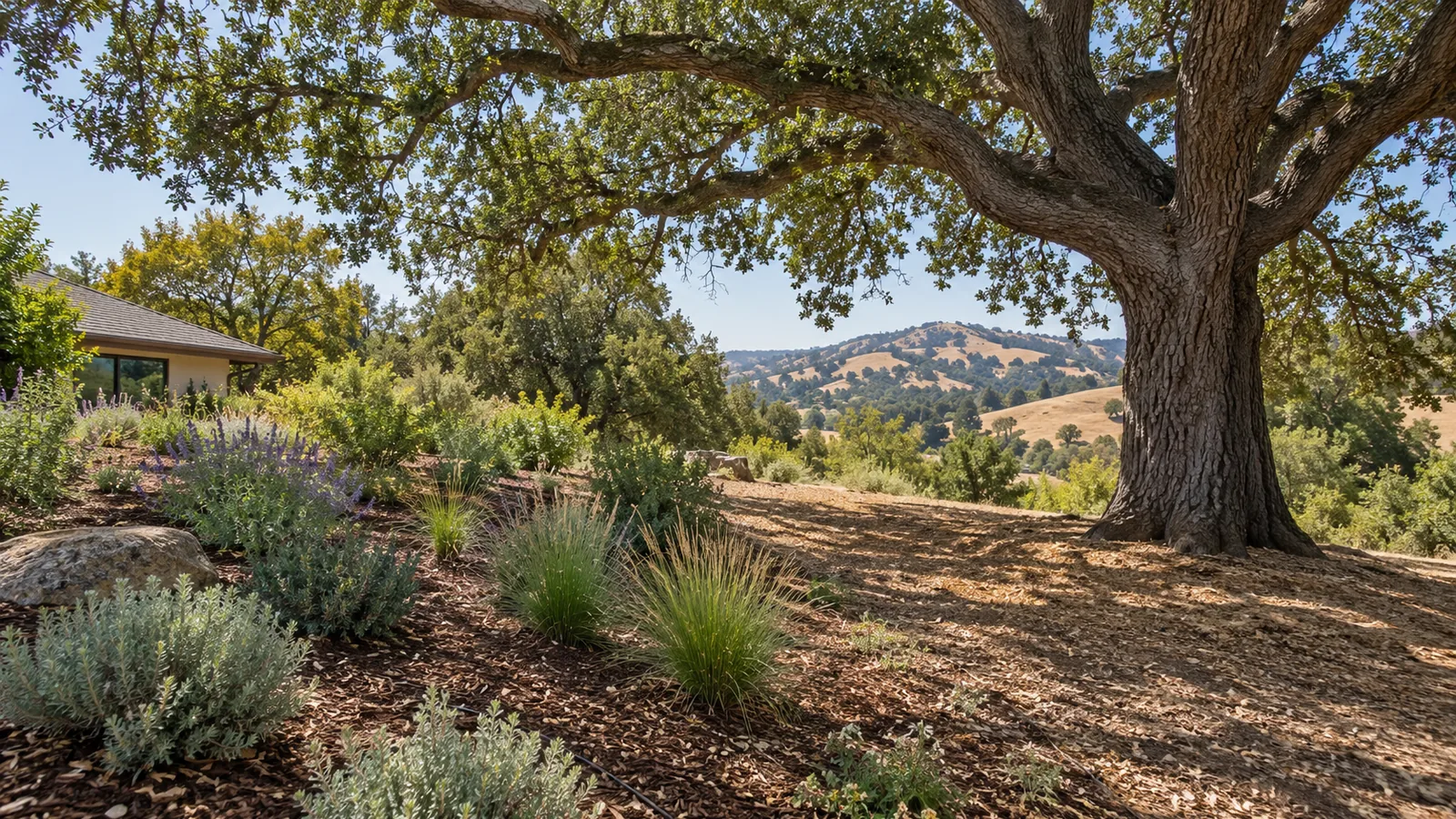
Landscaping around trees starts with protecting the roots before choosing plants or paving. In Saratoga, any tree 10 inches in diameter and ten native species from 6 inches are protected, so new planting, paving and irrigation near them should be planned around the root zone, and removal or heavy pruning needs a City permit. Street trees, Heritage Trees and required replacement trees are protected regardless of size, and work affecting roots can also require City permission (checked October 2026). For established native oaks, choose compatible planting and avoid introducing routine summer watering near the trunk. A new bed should fit the tree’s existing conditions. Landscape Associates of CA offers planting and landscaping around existing trees, with a free on-site estimate.
Which trees are protected in Saratoga
Saratoga protects every species at a trunk diameter of 10 inches or more, plus ten native species at 6 inches or more, measured 4.5 feet above ground. Street trees, Heritage Trees and required replacement trees qualify regardless of size (City rules, checked October 2026).
The City’s native list includes big leaf maple, black oak, blue oak, California buckeye, coast live oak, coast redwood, Douglas fir, scrub oak, tan oak and valley oak (checked October 2026). Identify the tree before using a size threshold.
Start your yard sketch with the trunk and canopy, then add the proposed planting beds and paths. UC explains that oak roots extend beyond the dripline, the outer edge of the canopy. That edge is a useful reference, not a line beyond which digging is automatically harmless.
What needs a City permit near a protected tree
The City regulates removal, certain pruning and root-zone disturbance. Even when work needs no Planning or Building permit, affecting a protected tree’s roots can require a tree encroachment permit. Use this table to identify the question to take to the City before work starts (checked October 2026).
| Work | City permit needed? | Who does it |
|---|---|---|
| Remove a protected tree, including a dead or fallen tree | Yes, a tree removal permit. Checked October 2026. | The City requires a business doing this work to hold a Saratoga business license and have an ISA Certified Arborist on staff in a supervisory role. |
| Prune more than 25% of the canopy, or outside ISA pruning guidelines | Yes, a pruning permit. Checked October 2026. | For structural pruning, the City requires a business with a Saratoga business license and an ISA Certified Arborist supervising on staff. |
| Grade, excavate, trench, park vehicles or store materials where roots will be affected | Yes, a tree encroachment permit if no Planning or Building permit is otherwise needed. Checked October 2026. | Ask the City Arborist about the proposed work and required protection before arranging installation. |
| Install paving within five feet of a protected tree’s canopy dripline | Yes, the City FAQ specifies a tree encroachment permit. Checked October 2026. | Discuss the location with the City Arborist before selecting the installation approach. |
| Plant without affecting a protected tree’s root zone | No trigger under that root-zone rule alone; this is not a blanket exemption from other project requirements. Checked October 2026. | Have the full planting scope checked with the City before treating it as permit-free. |
Sources: City of Saratoga Trees and Residential Development FAQ, checked October 2026. This table covers tree-related triggers.
Construction projects and building permits involving excavation must include the Tree Protection Plan/Disclosure Statement in the plan set, with an arborist report when required. The City includes grading, foundations, retaining walls and trenching in that scope, including overhanging trees (checked October 2026).
Planting under and around mature trees
Under a native oak, choose plants for the existing shade and dry summer conditions, and keep digging away from roots. UC recommends compatible plants that need no summer moisture once established (UC Sonoma guidance). UC San Luis Obispo suggests placing plants sparingly, so leaving open space can be a better choice than filling every gap.
Use a short selection checklist: does the plant tolerate the available light, does its established watering need suit the oak, and can it be planted without cutting roots? A plant described as drought-tolerant still needs a suitable location. The South Bay drought-tolerant plant guide is a starting point for ideas, not a list of plants approved for every oak.
Leave room around the trunk rather than banking soil against it. Avoid turning the whole area into a freshly tilled bed. UC Contra Costa advises against excessive digging and soil or mulch piled at the tree base. If the layout requires those changes, reconsider the bed’s footprint.
Paving, walls and trenching near roots
Plan the excavation before deciding where a path or wall belongs. UC advises against compacting soil, changing drainage, raising or lowering the grade, or trenching through native oak roots. A surface layout alone cannot show whether the work beneath it will disturb the tree (UC Fresno guidance).
When discussing pavers or retaining walls, ask where digging, material storage and equipment access would occur. Consider moving a feature before assuming roots can be cut to make it fit. Choosing a porous surface does not resolve those installation questions.
Saratoga’s FAQ requires an arborist report for wall construction, including underground foundations, within five feet of a protected tree’s canopy dripline (checked October 2026). Discuss the footing location, not just the visible wall face. No particular wall or patio placement is approved by this guide.
Watering near established trees
Established native oaks need a different watering discussion from new garden plants. UC warns that frequent summer irrigation can favor root disease, while drought-stressed urban oaks may need carefully planned supplemental water. Decide what the existing tree needs before adding an irrigation schedule for the bed (UC guidance).
For new compatible plants, UC recommends cautious hand watering or drip irrigation during establishment. That does not mean keeping the surrounding oak soil continually wet. Keep water off the trunk and avoid wetting its base, as UC Contra Costa advises.
Before changing an irrigation system, describe both the new plants and the existing tree. Avoid applying native-oak advice to every species in the yard. The useful question is where water will reach, including the trench needed to install a new line.
How we approach a yard with mature trees
Our service is planting and landscaping around existing trees. For a Saratoga yard, Landscape Associates of CA offers a free on-site estimate to discuss the planting you want. Our plant and tree installation service includes plants warrantied up to 1 year. Bring your ideas for beds and usable outdoor space.
For budget planning, see the Saratoga landscaping cost guide. Keep a sketch of existing trees beside your wish list so the planting conversation starts with what is already there.
Frequently asked questions
What size tree is protected in Saratoga?
Any species at 10 inches in diameter or more is protected, and ten listed native species qualify from 6 inches, measured 4.5 feet above ground. Street trees, Heritage Trees and required replacement trees are protected regardless of size (checked October 2026). Identify both the species and its protected status before assuming a smaller tree falls outside the City’s rules.
Do I need a permit to prune a tree in Saratoga?
A permit is required to prune more than 25% of a protected tree’s canopy or to prune outside ISA guidelines. The City’s business requirements also apply to structural pruning of protected trees (checked October 2026). Being below the percentage threshold does not settle every question. Describe the proposed cuts to the City before treating pruning as exempt from its permit requirements.
Can you plant under an oak tree?
Compatible planting is possible around an oak, provided the layout respects its roots and watering needs. UC recommends shade-compatible plants with no summer moisture needs once established. Keep planting away from the trunk, minimize disturbance and plan establishment watering carefully. A sparse arrangement is worth considering before a continuous bed, especially where installation would require digging through existing roots or changing the soil level.
Can I put pavers near a protected tree?
Pavers near a protected tree need site-specific review before installation. Saratoga requires a tree encroachment permit for paving within five feet of the canopy dripline (checked October 2026). Ask about the proposed excavation and equipment access as well as the finished surface. Do not treat a permeable product as permission to cut roots or as proof that the planned location is suitable.
Who can remove a protected tree in Saratoga?
The City requires a business removing protected trees to have a Saratoga business license and an ISA Certified Arborist on staff in a supervisory role. A removal permit is required, including for dead or fallen protected trees (checked October 2026). Confirm the permit and the business’s qualifications before arranging removal. These are City requirements for the removal provider, separate from planning new beds around a retained tree.
When is the best time to plant in Saratoga?
October to November is the best South Bay planting window listed on the plant installation page. UC also recommends fall planting around oaks so winter rain can help new plants establish. Use that window to plan suitable planting, rather than assuming the season makes every location appropriate. Root disturbance, shade and the water needed while plants establish still belong in the discussion before installation.
Planning new beds around an existing tree? Get a free on-site estimate from Landscape Associates of CA. Call or text (408) 207-5545 to discuss planting and landscaping around the trees in your Saratoga yard.
Get in Touch
Call us, send the estimate form, or email us. We reply within 24 hours to book a free site visit. Call or text (408) 207-5545.
- (408) 207-5545
- Text (408) 207-5545
- david@landscapeassociatesca.com
- Mailing address: 125 Surf Way #443, Monterey, CA 93940
- Mon - Fri: 8:00-5:00 · Closed on weekends