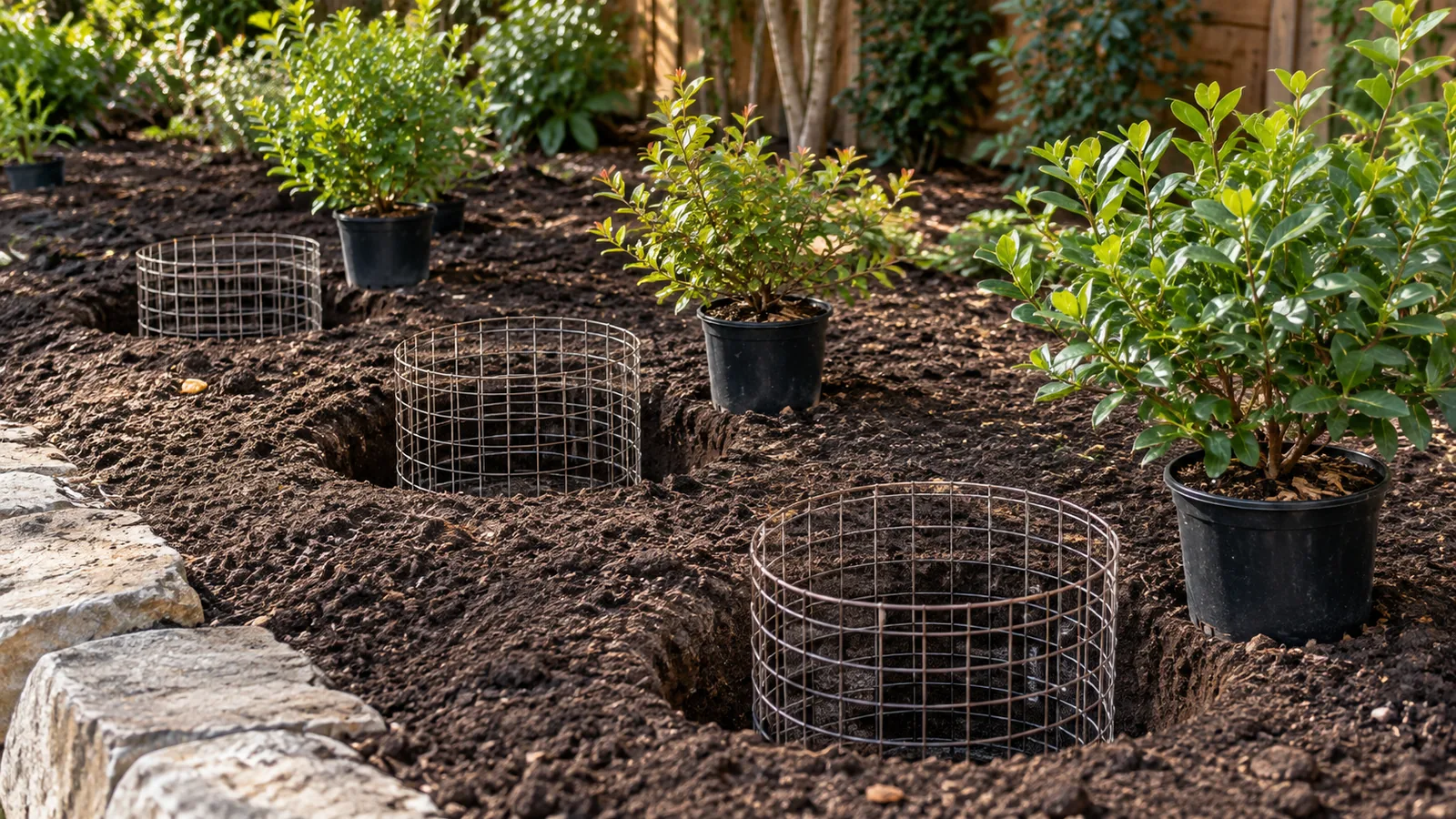
Start with the planting plan, then decide which roots or beds need protection and what each barrier can realistically do. Plan gopher protection before planting: UC IPM recommends installing wire baskets as plants go into the ground and screening beneath raised beds during construction, while barrier choice should account for root growth, site conditions and the limits of exclusion. The plan for a shrub is different from the plan for a raised vegetable bed or a lawn. Avoid buying one roll of mesh and assuming it suits every part of the yard. Ask about wire material, future root growth, access for irrigation repairs and the boundaries of the protected area. Landscape Associates of CA offers a free on-site estimate where you can raise those questions before committing to new planting or turf.
Why gophers damage landscape plantings
Gophers damage plantings because they eat vegetation and encounter roots while tunneling. UC IPM also describes irrigated gardens and lawns as favorable digging environments. The issue is food and soil conditions, rather than a landscape being new. Plan around the evidence on your property instead of assuming new plants are automatically protected.
The UC IPM Pocket Gophers Pest Note identifies fresh soil mounds as a useful sign of activity. It also explains that damage can include flexible irrigation lines. Before an estimate, photograph the affected area and mark which plants or parts of the lawn have been damaged. Bring those observations to the discussion rather than relying on a neighbor’s solution for a different yard.
Gopher protection methods for a new landscape
Plan gopher protection before planting: UC IPM recommends installing wire baskets as plants go into the ground and screening beneath raised beds during construction, while barrier choice should account for root growth, site conditions and the limits of exclusion. Compare the options below.
| Method | What it protects | How it is installed | Limits |
|---|---|---|---|
| Wire baskets for plants | Individual root areas | Install at planting. For shrubs and trees needing protection only while young, UC IPM specifies light-gauge, 3/4-inch non-galvanized steel wire. | Allow several years of root growth. Temporary wire is intended to rust away rather than constrain growing roots. |
| Underground fence around beds | A planting perimeter | UC IPM’s existing-planting guidance: hardware cloth or 1/2- to 3/4-inch mesh at least 2 feet deep, plus a 6-inch outward bend at 90 degrees and at least 1 foot aboveground. | Persistent gophers can pass below it; wire can restrict tree roots. Galvanized or stainless fencing lasts longer. |
| Raised beds with wire bottoms | The bed’s planting area | Place mesh under the soil during construction. UC IPM also describes screening both sides and bottoms of small beds. | Define the whole screened area before filling the bed; do not confuse a bottom screen with perimeter fencing. |
| Lawn areas | The proposed turf installation | A barrier manufacturer’s guidance puts wire after subgrade preparation and before topsoil and sod, with overlapped, pinned seams and finished edges without gaps. | UC IPM supplies no under-lawn wire specification. Lawn directions must come from the selected system, not the fence dimensions above. |
Source: UC IPM Pest Notes: Pocket Gophers for basket, bed and fence guidance. The lawn sequence is qualitative manufacturer guidance, not a UC installation recipe.
Do not read this comparison as a shopping list. Start by choosing the area you want to protect. A basket, a lined raised bed and a perimeter fence answer different questions. Ask for a drawing of the proposed boundary, including where it stops, before deciding that a particular method belongs in your plan.
What does not work
Do not make repellents or noise devices the foundation of a new planting plan. UC IPM reports no demonstrated plant protection from repellents and no support for proposed repellent plants such as garlic. It also rejects vibration and ultrasonic devices as reliable solutions. Keep these limitations in mind when comparing product claims.
A label that suggests an easy answer should prompt a specific question: what evidence supports protection of this planting? Ask for the test or guidance behind a claim, not just a testimonial. Choose the protection approach first; then decide what materials and maintenance it requires. Adding a gadget to an otherwise unfinished plan does not answer those questions.
For gopher control in San Jose, use the UC IPM guidance as a reference when evaluating advice. Keep a simple record of where fresh activity appears, and arrange follow-up if it continues. A finished planting project should have a clear next step for new damage, not an assumption that the issue is settled forever.
Planning protection into a new lawn or bed
Put protection decisions on the plan before planting begins. For beds, settle the screening approach during construction and the basket choice before individual plants go in. For a lawn, request instructions for the selected system. Coordinate grading, barrier placement, irrigation and planting rather than treating wire as an isolated last-minute addition.
- Define the layout and finish grades. Mark the future lawn, beds and individual planting positions. Identify existing irrigation and ask how it relates to the proposed protection. Write down which areas are included and which are outside the scope. If a new tree is part of the design, make future root room an explicit discussion item before selecting its basket.
- Choose the barrier and its role. Separate temporary young-plant baskets from longer-lived fencing. For a raised bed, resolve the bottom and side screening before soil is added. For a lawn, ask for the specific product and its instructions. Do not transfer the perimeter fence’s burial depth to a horizontal lawn installation simply because both use wire.
- Coordinate the irrigation details. Ask where lines cross the planned barrier and how someone will reach them later. Request an explanation of the order of work before approving the layout. Keep the plan and take photographs before underground components are covered. These are useful project records, especially if planting positions or irrigation routes change during construction.
- Confirm the plan before planting. Review the specified materials against the agreed scope. For baskets, check the chosen size against the anticipated root space. For a screened bed, ask to see the screen before filling. Keep the product instructions with the project records, and agree who you will contact if you notice damage after planting.
For a specific lawn system, a barrier manufacturer’s installation guide places wire after subgrade preparation and before topsoil and new sod, with overlapped, pinned seams and edges finished without gaps. That is manufacturer guidance for its system, not a UC IPM lawn specification or a universal recipe. Ask for the current directions for the material actually proposed.
Review plant and tree installation alongside the options for real and artificial turf so the discussion covers the whole layout. If you are choosing a planting palette, use the guide to drought-tolerant plants for San Jose for that separate decision. Do not assume a low-water planting list is a list of gopher-proof plants.
How we approach it
We discuss the layout with you at a free on-site estimate, so bring up gophers before settling the planting and turf plan. Ask us what protection should be considered, what needs product-specific advice and what is included in the proposed work. That conversation belongs alongside the rest of your landscape decisions.
Landscape Associates of CA designs and builds residential and commercial landscapes. When discussing landscape construction, bring your observations, photographs and priorities. Ask us at the estimate about protection before planting, and request clarity on the scope rather than assuming that wire installation is included. A useful plan identifies the planting areas, the open questions and the next decisions.
Frequently asked questions
How do you gopher-proof a new lawn?
Plan the lawn’s protection before turf installation and request product-specific guidance for any proposed wire system. UC IPM does not provide an under-lawn installation specification. The selected material’s instructions should address preparation, seams, edges and its position within the installation. Ask what the proposal covers, what it does not cover and how future work will be handled. Avoid treating a perimeter fence detail as a lawn recipe.
Do gopher baskets work?
Wire baskets are a UC IPM exclusion option for individual plants, provided root growth is considered. They belong in the planting discussion before a shrub or tree goes into the ground. Ask why the proposed basket’s size and material suit that plant, including whether protection is intended only while it is young. A basket is a defined root-area measure; do not assume it resolves every protection question elsewhere in the yard.
How deep should gopher wire be buried?
Depth depends on the barrier’s purpose; UC IPM’s perimeter fence guidance calls for at least 2 feet belowground. It also specifies an additional 6-inch outward bend at 90 degrees and at least 1 foot aboveground. Those are fence dimensions, not instructions for wire below a lawn or a universal basket depth. Ask for a detail showing the proposed barrier’s orientation, protected area and relationship to nearby plants before accepting a specification.
What plants do gophers avoid?
Do not rely on a plant choice as a proven gopher repellent. UC IPM says research does not substantiate claims for gopher purge, castor bean or garlic as repellents. That addresses repelling gophers from an area, not a promise about which individual plant will be eaten. Choose your planting palette for the site, then discuss root protection separately. Ask for evidence behind any claim that a plant will protect its neighbors.
Can gophers get through artificial turf?
Do not assume artificial turf itself is a gopher barrier. The UC IPM Pest Note does not establish whether gophers can penetrate a particular synthetic turf product. Ask the manufacturer and installer about the complete proposed assembly, whether rodent protection is part of it and what evidence supports their answer. Request that information before choosing the system, and keep any product-specific directions with the written scope for the project.
When should you install gopher protection?
Discuss protection before construction and planting, then match installation timing to the chosen method. UC IPM places baskets at planting and raised-bed screening during bed construction. A lawn requires its own system-specific sequence. Bring the question up before ordering materials so the layout, irrigation and planting decisions can be considered together. Ask for the agreed approach in the scope, and keep a record of what was installed before it is covered.
Planting a new landscape?
Bring gopher concerns into the conversation while the yard is still being planned. Tell us where you have seen activity, which areas you want to plant and whether turf is part of the project. Ask about protection before planting so the estimate can address your questions alongside the layout.
Call or text Landscape Associates of CA at (408) 207-5545, email david@landscapeassociatesca.com, or get a free on-site estimate. Replies within 24 hours.
Sources
- UC IPM, Pest Notes: Pocket Gophers, Publication 7433, updated June 2025
- Digger’s Product Development, Lawn & Turf Installation Guide, January 16, 2025; product-specific qualitative guidance
Get in Touch
Call us, send the estimate form, or email us. We reply within 24 hours to book a free site visit. Call or text (408) 207-5545.
- (408) 207-5545
- Text (408) 207-5545
- david@landscapeassociatesca.com
- Mailing address: 125 Surf Way #443, Monterey, CA 93940
- Mon - Fri: 8:00-5:00 · Closed on weekends